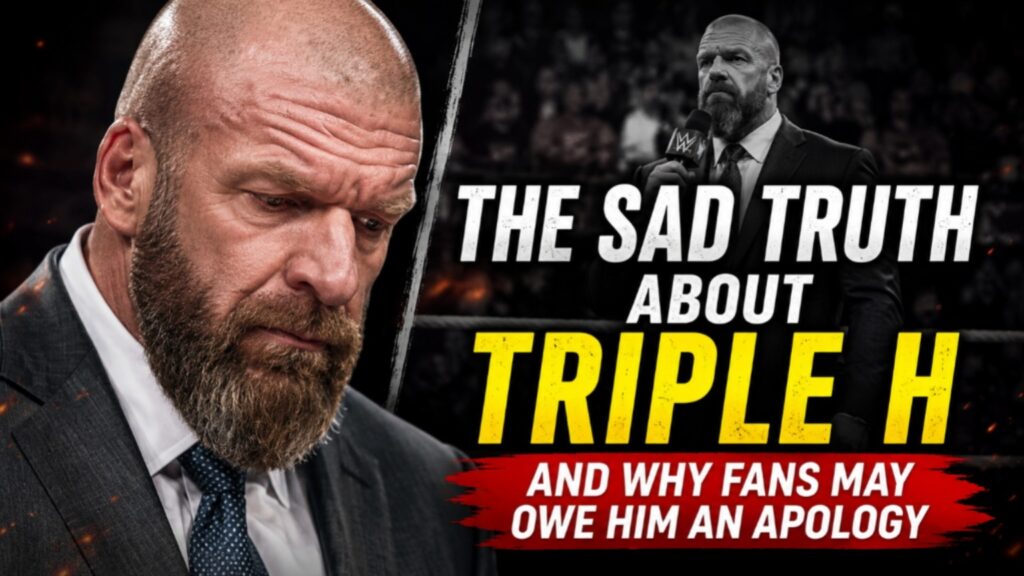
For months, Triple H has been the biggest target of fan criticism. Every strange booking decision, every celebrity segment that felt forced, and every storyline that failed to connect with fans was blamed on him. But now, new information has changed the conversation. The person fans believed was making those unpopular decisions may not have been Triple H after all.
The confirmation came from an unexpected source. Mark Shapiro, President and COO of TKO Group Holdings, was speaking to a small class at the University of Alabama when a student asked him why WWE has been featuring so many celebrities in its storylines, including Pat McAfee, Jelly Roll, Logan Paul, and IShowSpeed.
Instead of avoiding the question or putting the blame on WWE’s creative team, Shapiro gave a clear answer. He said that TKO has the final authority over WWE’s creative direction and that the company takes responsibility for everything that airs on television, whether fans like it or not. A student recorded the conversation, uploaded it to Reddit, and within a day it had spread across several wrestling news outlets.
The timing of Shapiro’s comments was also significant. They came shortly after Pat McAfee was added to the Cody Rhodes vs. Randy Orton title storyline on the road to WrestleMania 42. Fans had spent weeks wondering why a feud that had been building for months suddenly needed a celebrity involved. As usual, most of the criticism was directed at Triple H and his creative team.
Speaking at the University of Alabama, TKO President Mark Shapiro confirmed that TKO has “complete control” over WWE creative. pic.twitter.com/Zz3H8voPdL
— EliteRockerz 𝕏 (@EliteClubS0B) April 20, 2026
What Actually Happened Behind the Scenes
As wrestling journalists looked deeper into the story, a much clearer picture began to emerge. According to Dave Meltzer, the decision to insert Pat McAfee into the world title storyline did not come from WWE’s creative team. Instead, TKO CEO Ari Emanuel and President Mark Shapiro reportedly pushed for the move, even though some people on the wrestling side were against it. They believed that adding a celebrity to a feud that had been building for months would take attention away from the match itself. Meltzer also reported that TKO rarely steps in to override creative decisions, but when it did in this case, it led to internal disagreement and a strong negative reaction from fans.
Fightful’s Sean Ross Sapp later added more context during one of his subscriber Q&A sessions. He explained that TKO’s creative authority is not shared across the entire executive team. Instead, the final power is concentrated in Mark Shapiro and Ari Emanuel. Triple H still oversees WWE’s week-to-week creative, including the weekly television shows, mid-card storylines, and the build to Premium Live Events. However, when it comes to the company’s biggest storylines—especially around WrestleMania—TKO leadership can step in and issue specific creative directives.
What happened with the Pat McAfee storyline seems to support those reports. As fan criticism continued to grow, McAfee eventually removed himself from the angle, and the storyline ended much sooner than expected. During the WrestleMania 42 main event, Randy Orton hit McAfee with an RKO, clearing the way for Cody Rhodes to retain the Undisputed WWE Championship with a Cross Rhodes. A storyline that TKO reportedly pushed into WWE’s biggest feud ultimately failed to connect with fans and was wrapped up earlier than planned.
This Isn’t Actually New
None of this is new for WWE. Even during Vince McMahon’s era, the final creative decision always came from the person at the very top, while everyone else worked within that direction. The difference today is simply who holds that authority. Vince McMahon came from the wrestling business and spent decades building WWE, giving him a deep understanding of wrestling fans and storytelling. Mark Shapiro and Ari Emanuel, on the other hand, run a publicly traded entertainment and sports company that also owns UFC. Their priorities are naturally centered on business goals such as audience growth, streaming performance, and expanding WWE’s reach across multiple platforms, rather than the finer details of wrestling storytelling.
Shapiro’s own comments reflected that mindset. He highlighted WWE’s growing audience since Raw moved to Netflix, pointed to SmackDown’s continued success on USA Network, and noted that NXT now reaches around 100 million homes through The CW. At the same time, he openly acknowledged the downside. Because WWE’s programming is now spread across Netflix, USA Network, The CW, and ESPN’s streaming service, dedicated fans have to pay for more services than they did in the past to follow the entire product. Shapiro admitted that some fans may choose to stop watching because of those added costs.
That is a business decision made by business executives. It also helps explain why some of WWE’s recent creative choices have felt out of touch with what many wrestling fans wanted. When the focus is on growing the business and reaching a wider audience, creative decisions do not always align with the expectations of the core fanbase.
Where This Leaves Triple H

None of this means Triple H is completely free from responsibility for everything that happens on WWE television. It also doesn’t mean he has no input on creative decisions that fans dislike. What it does show is that the situation is far more complicated than simply saying, “Triple H made another bad booking decision.”
Triple H built his reputation by transforming NXT into one of wrestling’s most respected brands and later guiding WWE’s creative direction after Vince McMahon stepped away. During that period, many fans praised his approach to long-term storytelling and character development. By comparison, some of WWE’s more recent creative decisions—such as sudden storyline changes, an increased focus on celebrity involvement, and moments designed to create headlines rather than continue established stories—appear to align more closely with a corporate business strategy than with the creative style Triple H became known for.
That distinction is important. Since Mark Shapiro’s comments, additional reports, including follow-up reporting from Fightful, have continued to describe the same creative structure. Triple H remains in charge of WWE’s day-to-day creative direction, but Mark Shapiro and Ari Emanuel retain the authority to step in and override major creative decisions when the company’s biggest events are involved.
Several months have passed since the original controversy, and nothing reported since then has suggested that this decision-making structure has changed.
The Bigger Question
The bigger question going forward isn’t whether Triple H deserves criticism. It’s whether a corporate ownership group focused on streaming deals, subscriber growth, and business metrics can consistently make the right creative decisions for a storytelling-driven product like professional wrestling. Business priorities and wrestling storytelling don’t always align, and the Pat McAfee situation is a good example of what can happen when those two goals collide.
Fans who spent months blaming Triple H for every unpopular creative decision may now have reason to look at the situation differently. Based on the reporting that’s emerged, the responsibility for some of WWE’s biggest and most controversial creative calls appears to extend beyond Triple H and higher up the corporate chain, where the final authority over major decisions ultimately rests.

Gaurav Sharma
Founder & Lead Writer, Wrestling Nightmare
I’ve been hooked on wrestling since childhood—from the Attitude Era to today’s Bloodline saga, plus AEW and TNA. My favorite match of all time is The Rock vs. Brock Lesnar (SummerSlam 2002), and I’ll always stand by Bray Wyatt’s untapped potential.
At Wrestling Nightmare, I break down news, analyze matches, and drop verified recaps. Got a correction or wanna debate? Hit me up at contact@wrestlingnightmare.com