In the early 2000s, American televised wrestling placed heavy emphasis on heavyweight size and traditional brawling. While smaller performers were often relegated to cruiserweight divisions with strict weight ceilings, Total Nonstop Action (TNA) launched with an entirely different philosophy: “It’s not about weight limits; it’s about no limits.” Exploring the full TNA X-Division history reveals how an ambitious alternative brand built its foundation around relentless in-ring pacing, creating a style that fundamentally altered what fans expected from weekly television.
The Origin: Breaking the Traditional Cruiserweight Mold
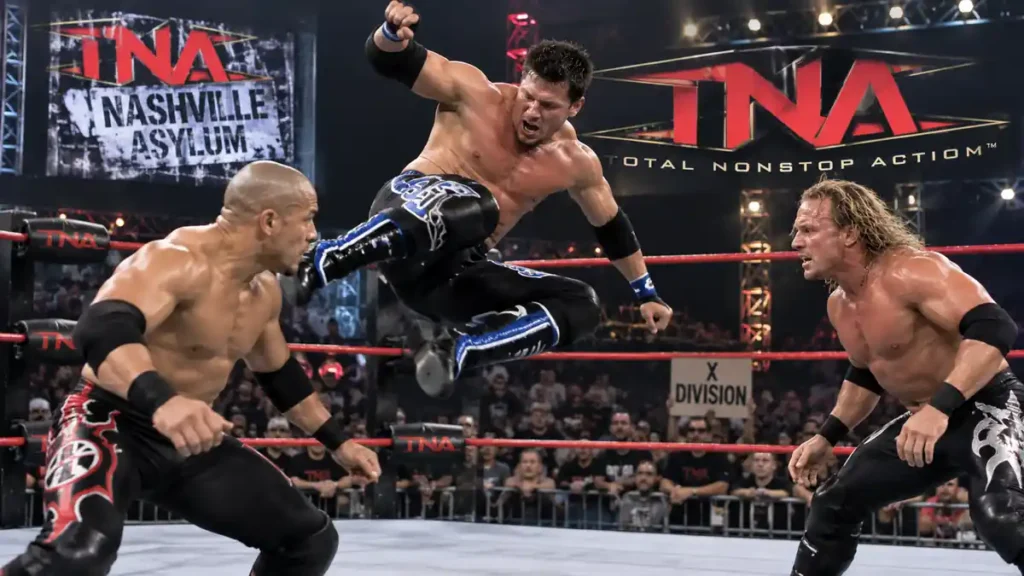
When TNA launched its weekly pay-per-view broadcasts in June 2002, the company needed an immediate hook to stand out against established wrestling brands. Traditional cruiserweight divisions had historically capped talent at 220 or 225 pounds, which often created an artificial barrier between athletic performers and the rest of the roster.
The X-Division took a completely different approach. Performers like AJ Styles, Low Ki, and Jerry Lynn helped establish the division’s distinctive blend of high-speed offense, technical wrestling, striking, and aerial maneuvers.
Crucially, removing the weight limit created compelling physical contrasts. A powerhouse athlete like Samoa Joe could enter the division, win its championship, and defend it against rapid-fire aerial specialists like Amazing Red. The message was simple: conditioning, speed, and endurance mattered far more than the number on a bathroom scale.
The Critical Peak: Unbreakable 2005 and Five-Star Acclaim
By 2005, the X-Division had become one of TNA’s most consistent sources of acclaimed in-ring competition. Matches like the 30-minute Iron Man battle between AJ Styles and Christopher Daniels at Against All Odds 2005 — rated 4¾ stars by the Wrestling Observer Newsletter — regularly stole the spotlight from heavyweight feuds.
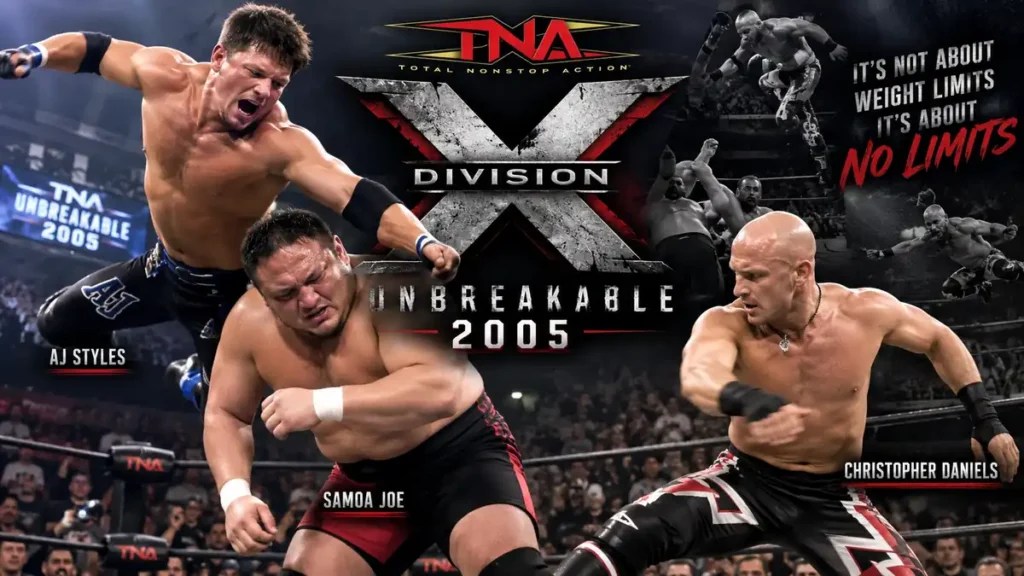
This run of critical momentum culminated on September 11, 2005, at TNA Unbreakable:
- The Unbreakable Three-Way: Christopher Daniels defended the X-Division Championship against AJ Styles and Samoa Joe in a breathless 23-minute battle.
- The Main Event Spotlight: In a bold creative statement, the X-Division Championship match was positioned as the main event of Unbreakable 2005, closing the show in place of the NWA World Heavyweight Championship.
- A Five-Star Milestone: The match received a five-star rating from Dave Meltzer in the Wrestling Observer Newsletter, marking the first time a TNA match had ever earned that distinction.
The contest proved that a secondary championship, built purely on athletic storytelling, precision counters, and unyielding drama, could carry a major pay-per-view broadcast on its own merits.
This wasn’t TNA’s only X-Division showcase from that stretch — the promotion’s Kurt Angle TNA run that followed a few years later leaned on that same X-Division-built in-ring credibility to anchor the company’s world title scene.
Also Read
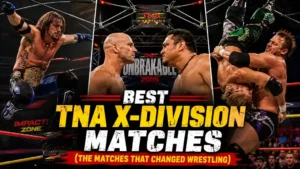
- 6 Best TNA X-Division Matches That Changed Modern Wrestling Forever
- 10 Former WWE Superstars Who Found Massive Success in TNA Wrestling
- Who Is Willow? Jeff Hardy’s Dark Alter Ego Explained
Signature Innovations: Ultimate X and Option C
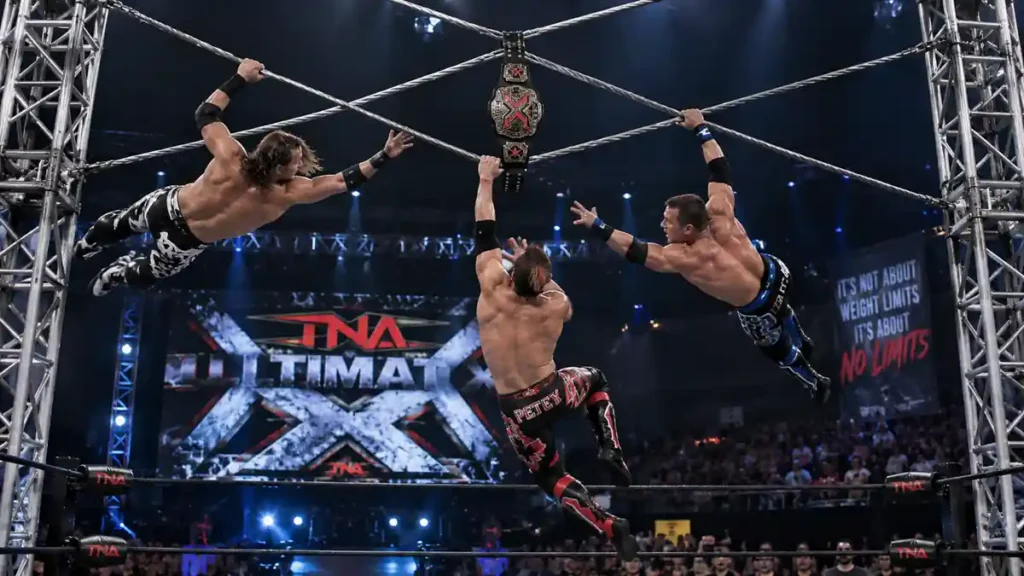
Beyond traditional singles matches, the X-Division introduced distinct match formats and creative concepts that gave the brand a lasting structural identity:
The Ultimate X Match
Conceived as TNA’s high-wire alternative to the standard ladder match, Ultimate X suspended the championship belt above the center of the ring on crossing steel cables. Debuting in August 2003, the format forced performers like Chris Sabin, Petey Williams, and Frankie Kazarian to combine grip strength, balance, and daring drops without the physical safety of a canvas directly beneath them.
The Creation of Option C
In 2012, TNA introduced an inventive way to bridge the gap between the mid-card and the top of the card known as Option C. Under this rule, reigning X-Division Champion Austin Aries chose to voluntarily surrender his championship in exchange for a direct shot at the TNA World Heavyweight Championship at Destination X.
Aries defeated Bobby Roode for the world title, and the concept subsequently became a recurring mechanism through which future champions, including Chris Sabin, could springboard directly into the world title picture.
Eras of the TNA X-Division
| Era | Defining Performers | Key Concepts | Legacy & Impact |
|---|---|---|---|
| 2002–2004 | Low Ki, Jerry Lynn, AJ Styles, Amazing Red | High-speed multi-man matches | Established the foundational “No Limits” identity |
| 2005–2007 | AJ Styles, Samoa Joe, Christopher Daniels, Petey Williams | Ultimate X & major PPV main events | Solidified the division’s reputation for workrate excellence |
| 2011–2014 | Austin Aries, Chris Sabin, Manik | Introduction of Option C | Created a direct pathway from the division to the World Title |
| 2020–Present | Josh Alexander, Mike Bailey, Mustafa Ali | Hybrid technical & international styles | Maintained the division’s high-workrate heritage in modern TNA |
Stylistic Influence on Modern Wrestling
While attributing industry-wide shifts to a single promotion is an overstatement, the X-Division undeniably helped popularize the fast-paced, hybrid wrestling that later became standard across modern promotions:
- Pacing and Dynamism: Major companies gradually shifted away from plodding, slow-tempo matches in favor of fluid, counter-heavy bouts featuring conditioned athletes across all weight classes.
- Roster Hierarchy: Performers who built their careers in the early X-Division proved that smaller, workrate-focused wrestlers could connect with mainstream audiences and serve as credible world champions.
- Match Construction: The intricate multi-person timing and aerial risks pioneered in early Ultimate X bouts helped shape modern multi-person showcase matches and ladder spots.
Final Thoughts
The X-Division was Total Nonstop Action’s most enduring and authentic creative contribution to the wrestling world. By removing artificial weight classes and prioritizing disciplined, high-velocity athletic storytelling, TNA created an alternative that felt distinct during an era dominated by corporate wrestling formulas.
Decades after its debut, the legacy of the X-Division remains unmistakable: it demonstrated that high-risk creativity, precision execution, and genuine in-ring passion will always find an audience.
Reference Links
- CAGEMATCH: AJ Styles vs. Christopher Daniels vs. Samoa Joe — Unbreakable 2005
- TNA X Division Championship — Title Lineage (Wikipedia)
- TNA Unbreakable (2005) — Full Event Card (Wikipedia)

About Gaurav Sharma
I am the founder, lead writer, and editor behind Wrestling Nightmare. I have been analyzing and following professional wrestling for years, with a deep focus on WWE, AEW, and TNA—spanning the Attitude Era, the Ruthless Aggression transition, and modern long-term booking eras like The Bloodline. My work centers on breaking down in-ring storytelling, creative booking decisions, and the business landscape of combat sports entertainment. When I am not breaking down pay-per-view match structures, I am tracking roster movements, injury reports, and backstage creative pivots to deliver grounded, hype-free pro wrestling analysis.
contact@wrestlingnightmare.com