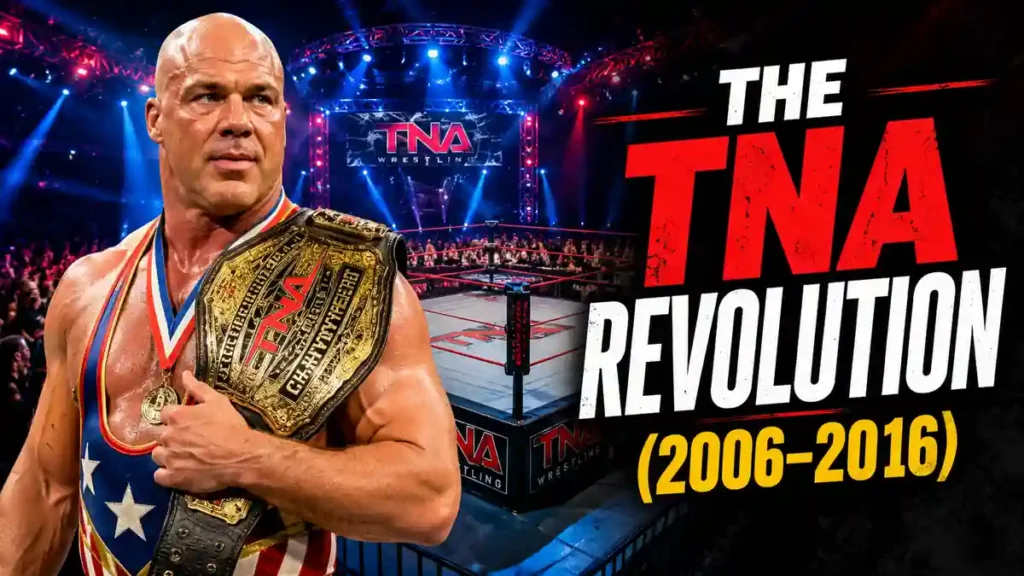
Kurt Angle TNA run turned out to be one of the best second acts in pro wrestling history. When he left WWE in 2006, I figured his best years were behind him. He’d won Olympic gold, spent years on a brutal WWE schedule, and the neck problems kept piling up. It honestly looked like the final chapter.
I was wrong, and I’m glad. Angle spent almost a decade in TNA (2006 to 2016), and he turned a scrappy underdog company into a place where serious in-ring storytelling actually mattered.
Kurt Angle in TNA: The Short Version
- 2006: Debuts with a headbutt on Samoa Joe, then ends Joe’s 18-month undefeated streak at Genesis.
- 2007: Becomes the first TNA World Heavyweight Champion at Sacrifice, then wins the title again at Slammiversary.
- 2007: Holds the World, X-Division and World Tag Team titles at the same time, becoming TNA’s second Triple Crown winner.
- 2007–2008: Wins the IGF version of the IWGP Heavyweight Championship, which gives TNA real exposure in Japan.
- 2008–2009: Leads the Main Event Mafia.
- 2013: Inducted into the TNA Hall of Fame.
Joining TNA at the Right Moment
By late 2006 TNA had a lot going for it. The X-Division was exciting and the Six Sides of Steel matches were chaotic fun. What it didn’t have was a true mainstream heavyweight.
Then Angle showed up. This was an Olympic gold medalist and a former WWE Champion who had recently main-evented with Brock Lesnar, The Rock and The Undertaker. Seeing him walk into the Impact Zone sent a clear message: TNA wasn’t just the alternative anymore. It wanted a seat at the big table.
Becoming the First TNA World Heavyweight Champion
In May 2007 the NWA ended its deal with TNA, which meant TNA needed a world title of its own, fast. According to Wikipedia’s event page, Angle beat Christian Cage and Sting in a three-way match at Sacrifice on May 13, 2007, to become the inaugural champion.
The finish was messy, though, with a second referee, a pin and a tap-out all tangled together. TNA settled it a month later with a King of the Mountain match at Slammiversary, and Angle won that one too. Looking back, I think that second win is the one that really made the belt feel legitimate.
He went on to win the title six times, a record for the company. Whenever it was on his shoulder, the main event felt serious and believable.
The Feuds That Defined His TNA Legacy
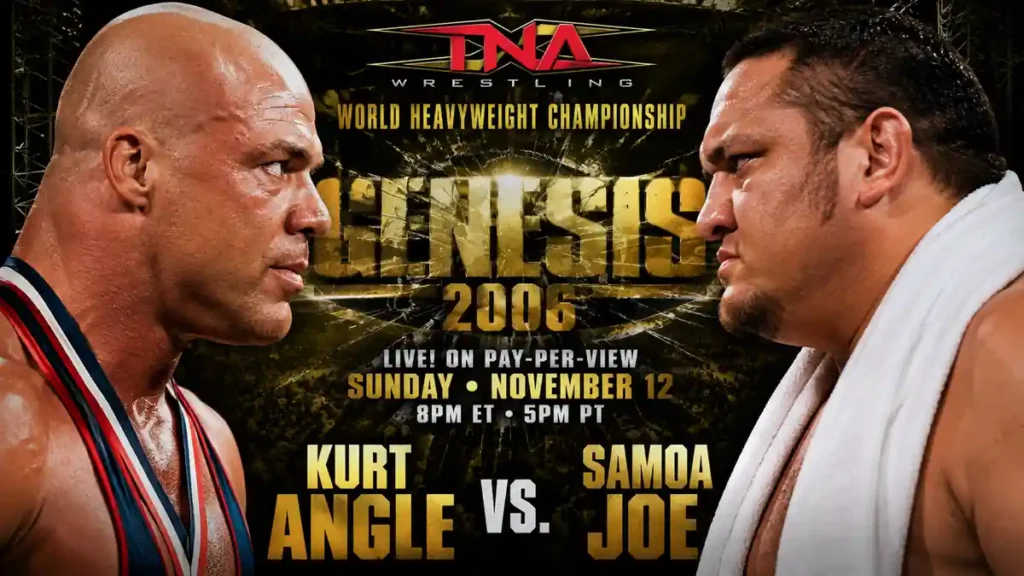
Samoa Joe
If I had to pick the best debut program in modern wrestling, Angle vs. Joe is near the top. After the headbutt, the two met at Genesis on November 19, 2006, and Angle made Joe submit to the ankle lock, ending the streak.
What I liked most was how it was booked. Angle didn’t come in to bulldoze the locker room. He treated Joe as a real threat, and that’s why it worked. They went on to a trilogy that closed with a 30-minute Iron Man match, which Angle won three falls to two.
Even Angle has admitted the feud was rushed. I get his point, but the matches still hold up.
AJ Styles and Bobby Roode
His battles with AJ Styles were a different kind of good. Styles was already the heart of the company, and trading technical counters with Angle pushed him into a different tier. Years later Angle played the same veteran test for Bobby Roode around Bound for Glory 2011.
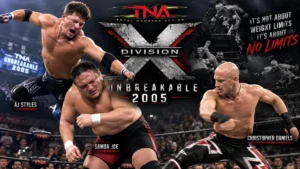
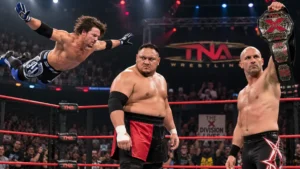
[AJ Styles vs Christopher Daniels vs Samoa Joe: TNA Classic Breakdown]
Holding All the Gold
Angle’s resume went well beyond the main event scene:
- X-Division Championship: A division built for cruiserweights, and the heavyweight Olympian won it anyway. That says a lot about his range.
- World Tag Team Titles: He won tag gold during his run too.
- The Triple Crown: Per Wikipedia, he became TNA’s second Triple Crown winner, holding all three titles at once.
- IWGP Heavyweight Championship: In 2007 he beat Brock Lesnar in Japan for the IGF version of the title, defended it under the TNA banner, and later lost it in a unification match against Shinsuke Nakamura in early 2008.
The Main Event Mafia and Wrestling Through Pain
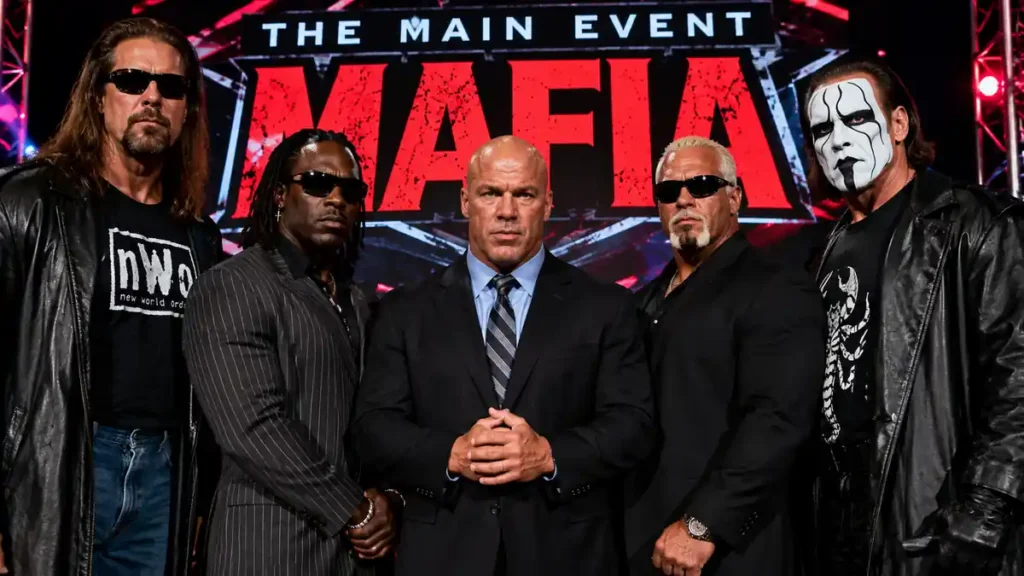
Angle moved easily between beloved technical hero and arrogant heel. As the leader of the Main Event Mafia, alongside Sting, Booker T, Scott Steiner and Kevin Nash, he gave TNA a proper old-guard-vs-new-generation story that ran for the better part of two years.
Watching it back now, I feel two things at once: awe, and a bit of worry. Angle was wrestling hard with a neck and spine that had been through a lot. His refusal to dial it down gave us great matches, but you can see what it cost him.
Why His TNA Legacy Still Stands Out
Angle never treated TNA like a retirement home. He used it to prove he was still one of the best wrestlers alive. By the time he went into the TNA Hall of Fame in 2013 (he’s the second man after Sting to be in both the WWE and TNA Halls) and left in 2016, he’d helped make stars out of Joe, Styles and Roode, and given TNA its best stretch of main-event wrestling.
For a company that always fought for respect, he wasn’t just another big signing. He was the anchor.
📌 Also Read: [TNA X-Division History: How TNA Redefined High-Flying Wrestling]
Frequently Asked Questions (FAQ)
How many times did Kurt Angle win the TNA World Heavyweight Championship?
Six times, which is a company record.
Did Kurt Angle beat Brock Lesnar in TNA?
Not in a TNA ring. In 2007, while under TNA contract, Angle beat Lesnar in Japan for the IGF version of the IWGP Heavyweight Championship.
When was Kurt Angle inducted into the TNA Hall of Fame?
In 2013.
Who was Kurt Angle’s biggest rival in TNA?
Most fans point to Samoa Joe, with AJ Styles a close second.
Further reading:
List of TNA World Champions, Wikipedia