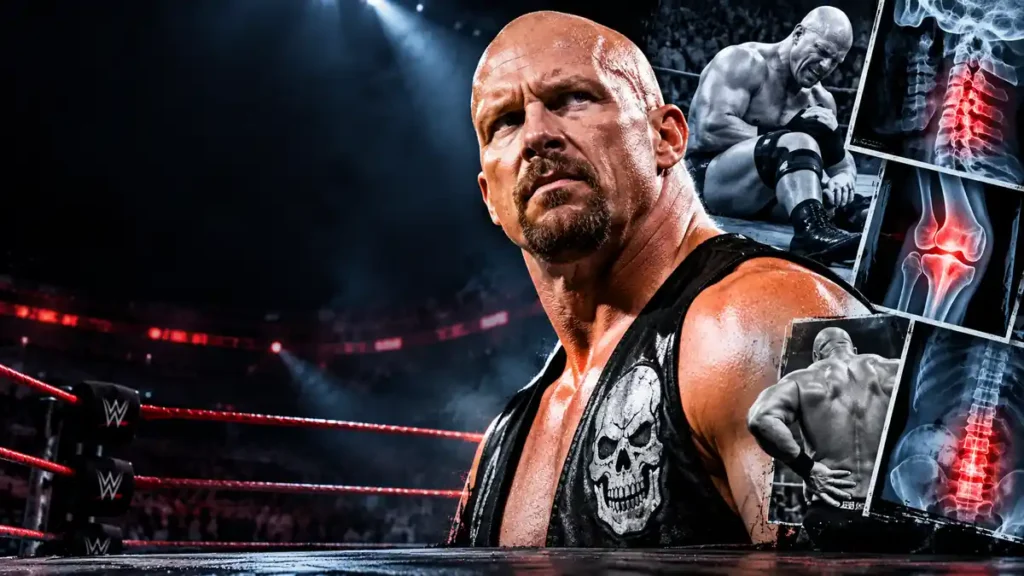
Stone Cold Steve Austin hidden injuries are the part of his story most fans skip. Everyone remembers the beer, the middle finger, and the Stunner. Fewer remember that a torn triceps cost Austin his WCW job in 1995, that a botched piledriver at SummerSlam 1997 damaged his neck for good, and that by 2003 that neck had ended his career.
This piece walks through those injuries in order. I’ve stuck to what the record supports, and where I’m giving my own read instead of a fact, I say so. If you like WWE history, the WWE section has more..
The 1995 Triceps Tear That Got Him Fired From WCW
Austin joined WCW in 1991 as “Stunning” Steve Austin and built a real résumé there. He held the United States and Television titles twice each and teamed with Brian Pillman as the Hollywood Blondes. By 1995 he was a solid hand the company could count on.
Then he tore his triceps on a tour of Japan. WCW boss Eric Bischoff let him go while he was still recovering, and the usual account is that the company didn’t see him as a marketable star.
Austin didn’t sit around. He landed in ECW, where he worked as “Superstar” Steve Austin from September to December 1995 and feuded with The Sandman and Mikey Whipwreck. The WWF signed him soon after. He started as the Ringmaster, and by March 1996 he was Stone Cold. That June, after beating Jake Roberts in the King of the Ring final, he cut the Austin 3:16 promo that changed everything.
Here’s my take: getting fired while hurt is where Austin the talker was born. In ECW he had nothing to protect, so he leaned on the microphone instead of trying to out-wrestle everyone. Plenty of fans would argue with that, but the promos from that stretch back it up for me.
SummerSlam 1997: The Night Owen Hart’s Piledriver Went Wrong
The feud was hot by the time SummerSlam arrived. Owen Hart pinned Austin in a five-on-five match at Canadian Stampede on July 6, and Austin attacked him the next day while Owen sang the Canadian anthem. Austin promised Vince McMahon he would take the Intercontinental Title back.
On August 3, 1997, he got his chance in front of 20,213 fans at the Continental Airlines Arena in East Rutherford, New Jersey, according to Cagematch’s event page. The plan called for Owen to hit a sit-out piledriver on Austin. Austin has said he wasn’t sure the move was a good idea because he doubted his head could be protected. He was right to worry. Owen botched it and dropped Austin on top of his head. Austin’s neck jammed, and he was temporarily paralyzed.
Nobody involved wanted that outcome. Owen made a mistake on one of the riskiest moves in wrestling. Austin finished the match, pinned Owen, and left with the title. Cagematch lists the match at 16:16 as a title change, and fans in the review section keep making the same point: it was building into something special before the finish.
The labels vary depending on who tells the story. WWE’s own recap says Austin broke his neck. Other accounts describe a bruised spinal column and temporary paralysis. Either way, the result was the same. His neck never felt right again. WWE later banned the piledriver for most of its roster after incidents like this one.
Owen died in a 1999 accident at Over the Edge, which is part of why many fans find this story hard to revisit. It’s also why it deserves to be told carefully.
Fusion Surgery and a Neck That Never Fully Healed
The injury put Austin out of action for months, but he came back. He won the 1998 Royal Rumble, and at WrestleMania XIV that March he beat Shawn Michaels for the WWE Championship. The Attitude Era had its face. Over the next few years his feuds with Vince McMahon and The Rock made him the biggest star in the company, and several WWE executives, including Jim Ross, have called him the most profitable wrestler in WWE history.
His neck paid the bill. Austin had fusion surgery in 1999, and the neck never fully healed. He spent most of 2000 away from television, then came back and kept going. 2001 was the last year he worked a full-time schedule. He walked out on the company in 2002 before returning for a final run.
His last match came against The Rock at WrestleMania XIX on March 30, 2003, and Austin lost. Long-term damage to his neck forced him to retire at 38. That’s young for a man who had been the biggest star in the business only a couple of years earlier.
What I Think the Injuries Did to His Style
This section is my opinion, not settled fact.
Watch Austin’s submission match with Bret Hart at WrestleMania 13 in March 1997, then watch his WrestleMania XIV main event a year later. The first is a long, technical story that ends with a bloody Austin refusing to quit in the Sharpshooter, and many fans rank it among the best matches ever. The second leans on punches, stomps, and the Stunner. My read is that after SummerSlam, Austin took fewer risks with his neck and leaned harder on the brawler persona.
It worked because it fit the character. A guy who hates his boss shouldn’t be flying around the ring. I can’t separate how much of that shift was a creative choice and how much was the neck forcing his hand.
Star ratings don’t capture a change like that. If you’re curious how critics score matches, I broke down the Meltzer star rating system. Austin also shows how a heel can win a crowd by accident: WWE booked him as a heel at first, and the fans cheered him anyway. For a modern look at how WWE handles those turns, see the Seth Rollins heel turns timeline.
What the Injuries Cost Him, and What They Left Us
I don’t want to romanticize any of this. Austin paid for those years with his neck. The injuries didn’t make him great. His charisma, his timing, and his feuds with McMahon and The Rock did that. What the injuries did was shape how he worked and how long he lasted. We got a short, intense run instead of a long, careful one, and I think that urgency is part of why those years still hit.
Wrestling characters land hardest when something true sits underneath them. For a current AEW example, check out MJF’s heel persona.
Austin’s Injury Timeline at a Glance
- 1995: Torn triceps on a Japan tour, and WCW lets him go
- August 3, 1997: Botched piledriver from Owen Hart at SummerSlam
- 1999: Neck fusion surgery
- March 30, 2003: Final match against The Rock at WrestleMania XIX
Which Austin match shows him at his best while he was hurt? Tell me in the comments.
Frequently Asked Questions
Who injured Steve Austin’s neck at SummerSlam 1997?
Owen Hart did, by accident. On August 3, 1997, Owen botched a sit-out piledriver during their Intercontinental Title match and dropped Austin on his head. Austin still finished the match, pinned Owen, and won the title. You can check the result on WWE’s SummerSlam 1997 page.
Did Steve Austin really break his neck?
It depends on who tells the story. WWE’s own recap says he broke his neck, while other accounts describe a bruised spinal column and temporary paralysis. Either way, the injury never fully healed.
Why did WCW fire Steve Austin in 1995?
Austin tore his triceps on a tour of Japan, and WCW let him go while he was still recovering. The usual account is that the company didn’t see him as a marketable star.
When did Stone Cold Steve Austin retire, and why?
His final match came against The Rock at WrestleMania XIX on March 30, 2003. Long-term neck damage forced him to retire at 38. He had fusion surgery in 1999, and the neck never fully healed.
Did his injuries change Austin’s wrestling style?
That one is my opinion, not settled fact. I think Austin took fewer risks with his neck after SummerSlam 1997 and leaned harder on the brawler persona. Put his WrestleMania 13 match with Bret Hart next to his WrestleMania XIV main event, and the shift shows up for me.

About Gaurav Sharma
I am Gaurav Sharma, founder and the only writer at Wrestling Nightmare. I live in Punjab, India. I have watched professional wrestling since 2000, and for the last 15 years I have followed dirtsheet reporting and the difference between what is shown on screen and what is reported from backstage. I write explainers and labeled opinion on WWE, AEW, and TNA. I credit the outlet that broke a story, and I do not publish unsourced salary figures or private family pieces.
contact@wrestlingnightmare.com