
Every time a big match ends, the same argument plays out online. Someone shares that Dave Meltzer gave it five stars. Someone replies that it was nowhere near that good. A third person says star ratings are pointless anyway.
Honestly, all three have a point. That’s why the Meltzer star rating deserves a proper look, because it’s the most quoted number in wrestling and probably the most misunderstood one too.
What the Meltzer Star Rating Is Trying to Capture
A rating tries to squeeze several things into one number:
- Execution: clean moves, smooth transitions, wrestlers who look in control
- Storytelling: the match builds, the finish makes sense, and big moments feel earned
- Crowd reaction: a hot crowd can lift a match, and a dead one can sink it
- Pacing and drama: near-falls that land and a match that doesn’t drag
- Context: a title change or the end of a long feud feels bigger than the moves alone
So the number is part craft and part feeling. That mix is exactly why people disagree about it, because everyone weighs those pieces differently.
What a Star Rating Doesn’t Tell You
This is where most online arguments go off the rails.
It isn’t a fact. There’s no formula behind it. Two experienced critics can watch the same match and land a full star apart without either being wrong.
It doesn’t tell you if you’ll enjoy the match. A five-star classic can bore a casual fan. A messy two-star brawl can be the best thing you watch all week. Comedy, character work, and old-school pacing usually score lower even when the crowd loved every second.
It ignores business. The match that sold the most tickets or made a new star often isn’t the highest rated. Wrestling is a business first, and stars barely touch that side.
It judges one match at a time. A great match on a badly booked show feels different from the same match on a perfect night.
It reflects era and taste. Fans who grew up in the 80s, the Attitude Era, or today’s indie scene value different things.
Why People Still Care
If the system has so many limits, why has it lasted so long? A few reasons.
It gives fans a quick shared language. Saying “that was a four-star match” beats typing a paragraph. It also works like a viewing guide: scroll through the top-rated matches of any year and you’ll find gems you’d have missed. And it starts debates, which, let’s be honest, is half the fun of being a fan.
Also Read-:Undertaker vs Shawn Michaels WrestleMania 25: The Anatomy of a Classic
Critic Ratings vs Fan Ratings
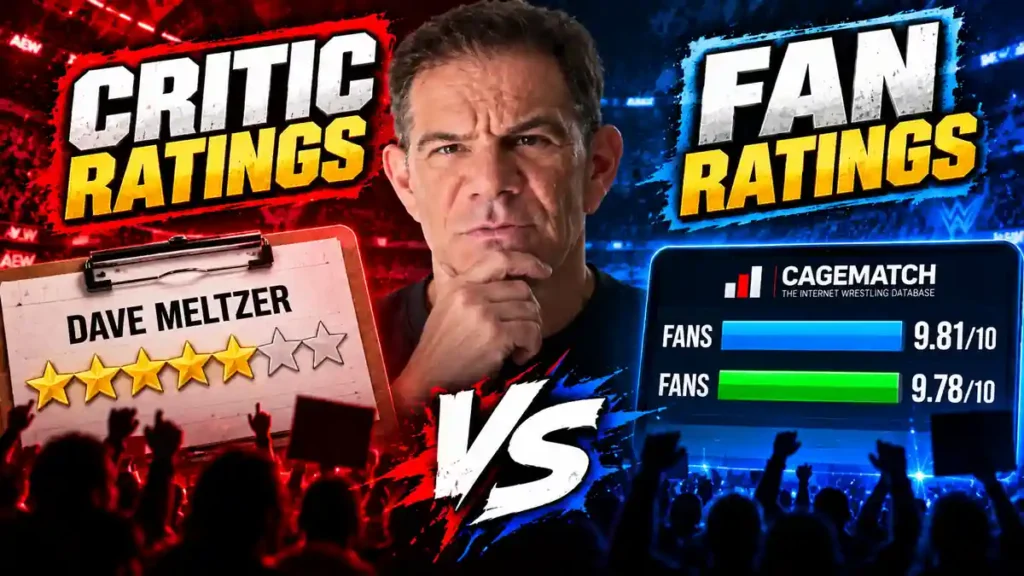
Meltzer isn’t the only source. Fan sites like Cagematch collect votes from thousands of viewers and publish averages out of ten. Those averages tend to favor big, emotional, high-profile matches, and fresh matches often get a rush of excited votes that cools down later.
Fan votes tell a similar story with a twist. Both Okada vs Omega matches above average close to 9.8 out of 10 from over a thousand votes each. Yet in the comments you’ll still find viewers calling the Dominion match slow and overrated, and a few arguing no match deserves more than five stars at all. Even when almost everyone agrees a match is great, the disagreement never fully goes away.
Neither side is “right.” A critic gives you one experienced, consistent perspective. Fans give you the crowd’s collective mood. Read both and you get a much more balanced picture.
Fair Criticisms of the System
It’s only honest to mention the complaints. Some fans feel the scale rewards spectacle over substance and pushes wrestlers to chase bigger moves. Others point out that top-range ratings have become more common over time, and the jump from six stars to seven for the same pairing is exactly the kind of thing they point to. Some also believe a promotion’s reputation can quietly influence how a match is received, even if nobody means it to.
None of this makes the system useless. It just reminds us that it’s a human opinion formed in a particular time and culture.
Why I Don’t Judge a Match by Its Star Rating Alone
I think a match should be judged by how it makes you feel, not just by the number attached to it. A technically brilliant match can impress critics, but sometimes a simple rivalry with strong storytelling stays with fans far longer. Meltzer’s ratings help me find matches worth watching, but my final opinion always comes from watching the match myself.
The Rock vs. Hollywood Hulk Hogan at WrestleMania X8 is a perfect example of why star ratings don’t always capture a match’s full impact. Dave Meltzer rated it three stars, but the Toronto crowd’s incredible reaction turned the showdown into one of WWE’s most unforgettable matches. The atmosphere, the generational clash, and Hogan’s unexpected fan support made it feel much bigger than a number on a review. Sometimes, the connection between wrestlers and fans matters just as much as in-ring technique.
If you want more analysis like this, check out [Tag Team Wrestling Rules Explained: Legal Man & Tags
] and [Royal Rumble Match History: How One Concept Changed WWE Storytelling].
How to Use the Meltzer Star Rating Without Getting Frustrated
- Treat it as a recommendation. A high rating means the match is worth your time, not that you have to love it.
- Find a critic whose taste matches yours. After a while you’ll know whether you usually agree or disagree.
- Watch first, compare later. Ratings can set your expectations too high or too low.
- Read the review, not just the number. The explanation behind the score is more useful than the digit.
The Bottom Line
The Meltzer star rating is an informed opinion packaged as a number. It started as one journalist’s quick way to flag quality, turned into a language fans around the world share, and survived because wrestling fans love arguing about what counts as great.
It can’t tell you what you’ll enjoy or what made money. It can tell you what one respected observer thought of the in-ring work that night. Used that way, it’s a great tool for finding good matches and starting better conversations.
So next time you see a number next to a match, ask what it’s actually measuring. Then watch it and decide for yourself.

About Gaurav Sharma
I am Gaurav Sharma, founder and the only writer at Wrestling Nightmare. I live in Punjab, India. I have watched professional wrestling since 2000, and for the last 15 years I have followed dirtsheet reporting and the difference between what is shown on screen and what is reported from backstage. I write explainers and labeled opinion on WWE, AEW, and TNA. I credit the outlet that broke a story, and I do not publish unsourced salary figures or private family pieces.
contact@wrestlingnightmare.com