
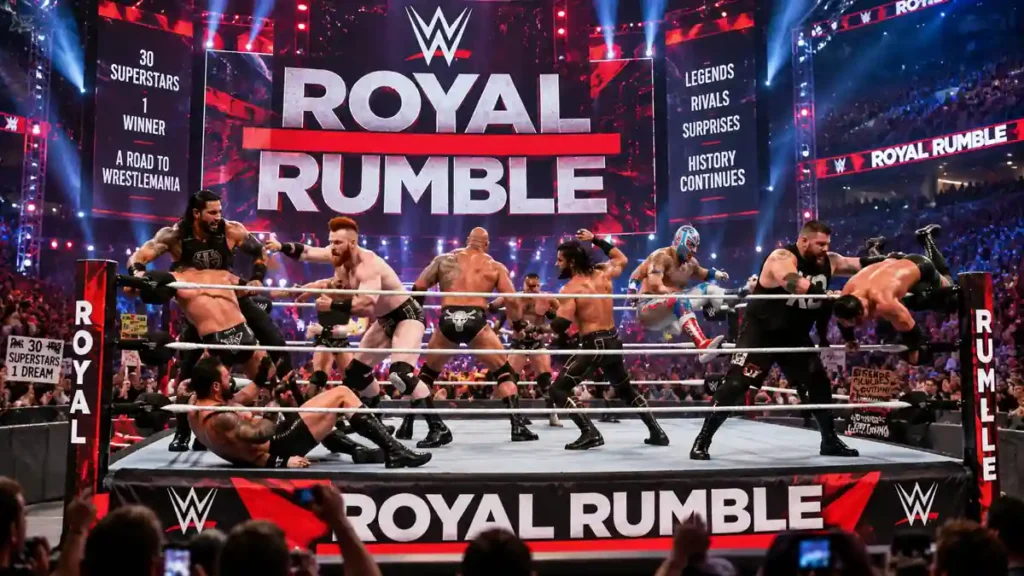
In professional wrestling, sustained audience anticipation is difficult to maintain across long-form multi-person matches. Historically, regional promotions used battle royals as reliable box-office attractions, placing dozens of competitors inside the ring simultaneously. Yet these bouts often suffered from physical congestion, limited visibility, and static brawling. Examining the complete Royal Rumble match history illustrates how an alternative structural pitch by WWE Hall of Famer Pat Patterson transformed multi-wrestler presentation. By introducing staggered entry intervals, WWE turned an inherently chaotic contest into a structured episodic showcase that eventually became the primary promotional engine leading toward WrestleMania.
The Genesis: Overcoming the Traditional Battle Royal Flaw
For decades, standard battle royals placed twenty or thirty competitors into a single ring at the opening bell. Because the canvas was immediately crowded, dynamic athletic exchanges were virtually impossible. Wrestlers were largely forced to lean against the turnbuckles, throw punches, and wait for predetermined eliminations before the ring cleared enough to showcase distinct styles.
Pat Patterson proposed an operational shift: begin the match with two participants and introduce remaining competitors individually at timed intervals. This allowed each entrant a spotlight entrance, reset the crowd’s focus, and gave the match clean chapters.
The format debuted as a live television special on the USA Network on January 24, 1988, at the Copps Coliseum in Hamilton, Ontario:
- The Original Format: The inaugural television event featured a 20-entrant field, with competitors entering at roughly two-minute intervals.
- The First Entrant: Bret Hart drew entry number one, remaining in the ring for over twenty-five minutes and demonstrating the pacing potential of an early participant.
- The Inaugural Winner: “Hacksaw” Jim Duggan entered at number 13, ultimately eliminating One Man Gang to secure the victory.
The broadcast drew a strong television rating on USA Network, prompting WWE to expand the field to thirty participants and establish the Royal Rumble as an annual pay-per-view event beginning in January 1989 in Houston, Texas.
Also Read-:WWE Intercontinental Championship History: Legacy, Greatest Champions & Evolution
1990–1992: From Showcase to Championship Stakes
The match format quickly became a testing ground for major program chemistry. At the 1990 Royal Rumble in Orlando, Florida, reigning WWF Champion Hulk Hogan and Intercontinental Champion The Ultimate Warrior squared off mid-match. The sustained crowd reaction during their brief confrontation served as a clear indicator of audience demand, solidifying their marquee title-for-title clash at WrestleMania VI later that spring.
The event’s competitive significance shifted permanently in January 1992 in Albany, New York.
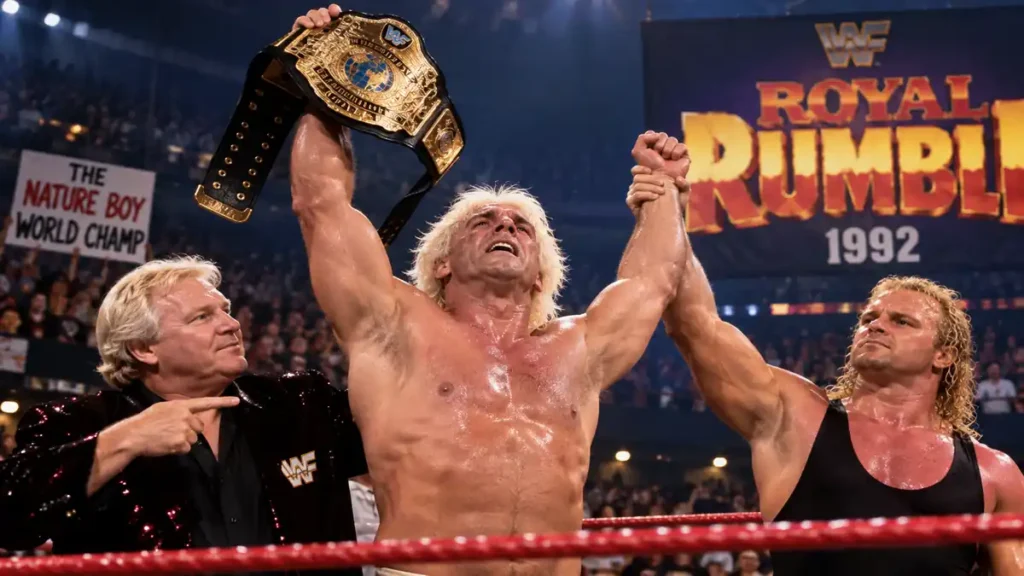
Following disputed title finishes between Hulk Hogan and The Undertaker late in 1991, WWE President Jack Tunney vacated the WWF Championship, announcing that the vacant title would be awarded directly to the winner of the Royal Rumble:
- The Number Three Draw: Ric Flair entered at number three and wrestled for over an hour, working through physical sequences against Roddy Piper, The Undertaker, and the British Bulldog.
- The Finish: In the closing moments, Sid Justice eliminated Hulk Hogan. While an agitated Hogan grabbed Sid’s arm from the arena floor outside the ring, Flair seized the opening from behind, lifting Sid over the top rope to claim the championship.
The 1992 edition proved that the staggered-entry format could carry the weight of a premier world championship without relying on standard one-on-one singles structures.
Also Read-: Hangman Adam Page AEW Storyline From Self-Doubt to World Champion
The WrestleMania Stipulation and Format Evolution
In 1993, WWE formally linked the match to its premier spring event by awarding the Royal Rumble winner a World Championship match at WrestleMania. Yokozuna won the 1993 match by eliminating Randy Savage, securing a title opportunity against Bret Hart at WrestleMania IX.
While this stipulation established the seasonal road to WrestleMania, the format adjusted over subsequent decades:
- The Split-Roster Eras: Following WWE’s brand split in 2002, the prize expanded. Winners earned the right to challenge for their choice of world championship across Raw and SmackDown, adding drafting intrigue to the match payoff.
- Milestone Victories: In 1995, Shawn Michaels became the first competitor to win the match from the number one spot. In 2006, Rey Mysterio set an endurance record for the classic 30-participant field, entering at number two and lasting over 62 minutes to win.
Key Eras in Royal Rumble Match History
| Era & Years | Notable Winners | Structural Developments |
|---|---|---|
| Foundational Era (1988–1991) | Jim Duggan, Big John Studd, Hulk Hogan | 20-entrant pilot evolved into an annual 30-participant pay-per-view. |
| World Title Era (1992–1997) | Ric Flair, Yokozuna, Bret Hart / Lex Luger, Shawn Michaels | 1992 title defense; WrestleMania title-shot stipulation introduced in 1993. |
| Attitude Era (1998–2002) | Steve Austin, Vince McMahon, Triple H | Faster pacing, ringside storyline integrations, and heavy faction brawling. |
| Brand Extension (2003–2017) | Brock Lesnar, Batista, Rey Mysterio, John Cena | Winners chose between multiple world championships across Raw and SmackDown. |
| Dual-Division Era (2018–Present) | Asuka, Drew McIntyre, Cody Rhodes, Rhea Ripley | Launch of the annual 30-Woman Royal Rumble; revival of 60+ minute workrate performances. |
Structural Mechanics: Pacing the Hour-Long Match
The longevity of the Royal Rumble format relies on specific operational elements that balance match timing and crowd engagement:
- Timed Resets: The countdown buzzer creates rhythmic resets. Even when ring action slows down, the imminent arrival of a new entrant redirects crowd attention toward the entrance stage.
- Protected Outcomes: Two top performers can engage in competitive exchanges without either wrestler absorbing a televised pinfall or submission loss, allowing ongoing feuds to progress cleanly.
- Functional Roles:
- The Endurance Anchor: Early entrants who direct traffic and maintain physical structure across long stretches, such as Chris Jericho’s over-60-minute performance in 2017.
- The Dominator: Competitors who quickly clear accumulated bodies from the ring to re-establish spatial clarity. In 2020, Brock Lesnar eliminated 13 participants before being eliminated by eventual winner Drew McIntyre.
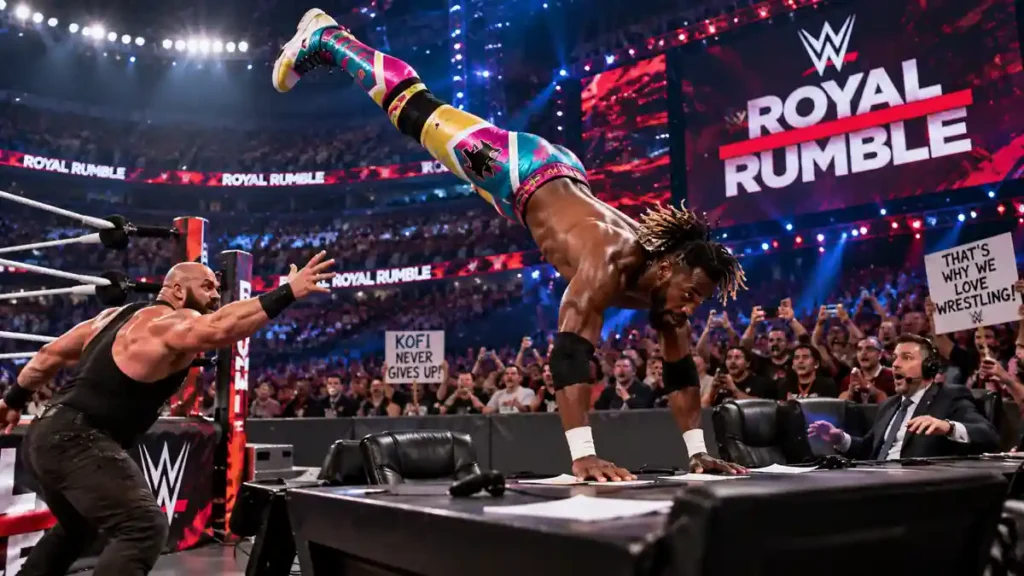
- The Avoidance Spot: Performers who utilize ring barricades, announce tables, or athletic footwork to avoid having both feet touch the arena floor, a trope popularized by Kofi Kingston.
Also Read-:7 WWE Wrestlers Who Changed Gimmicks and Became Global Icons
Modern Milestones: The Women’s Rumble and Endurance Records
In January 2018 in Philadelphia, WWE established the Women’s Royal Rumble as an annual fixture. Featuring a full 30-participant field, timed entry intervals, and a WrestleMania championship opportunity, the inaugural match was won by Asuka entering from the number 25 position. The addition gave the women’s division structural parity on the company’s major event calendar.
Recent editions have also highlighted modern stamina benchmarks:
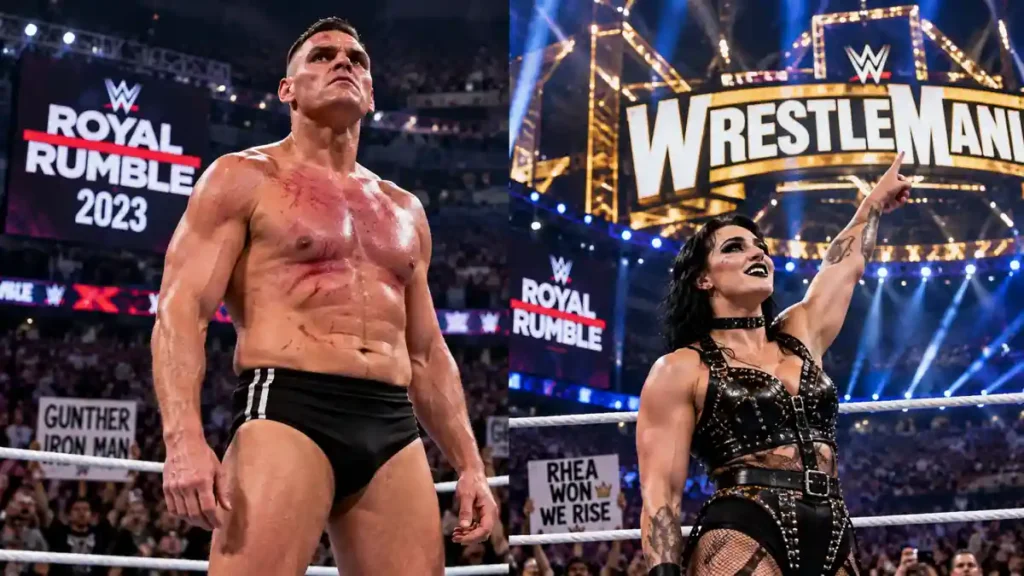
- In the 2023 Men’s Royal Rumble, Gunther entered at number one and lasted one hour, eleven minutes, and 25 seconds — the longest performance in traditional 30-participant Royal Rumble history — before being eliminated by final entrant Cody Rhodes.
- The women’s match established similar endurance marks, with Rhea Ripley winning the 2023 edition from the number one spot, recording over an hour inside the ring.
Analytical Overview
The Royal Rumble endures because its underlying framework is structurally flexible. While individual booking choices and winners have drawn varied reactions over the years, the staggered-entry format remains one of wrestling television’s most durable concepts. By organizing a field of competitors into measurable episodic chapters, Pat Patterson’s original idea continues to define how WWE builds dramatic momentum each winter on the road to WrestleMania.
Sources & Documentation

About Gaurav Sharma
I am the founder, lead writer, and editor behind Wrestling Nightmare. I have been analyzing and following professional wrestling for years, with a deep focus on WWE, AEW, and TNA—spanning the Attitude Era, the Ruthless Aggression transition, and modern long-term booking eras like The Bloodline. My work centers on breaking down in-ring storytelling, creative booking decisions, and the business landscape of combat sports entertainment. When I am not breaking down pay-per-view match structures, I am tracking roster movements, injury reports, and backstage creative pivots to deliver grounded, hype-free pro wrestling analysis.
contact@wrestlingnightmare.com
Related posts:
 Seth Rollins Heel Turns: Complete WWE History & Timeline Explained
 Sheamus’ WWE Legacy: Ranking His Title Reigns, Best Matches, and The Bar Era
 Ranking Every Match in The Undertaker’s Legendary WrestleMania Streak (21-0)
 WWE Intercontinental Championship History: Legacy, Greatest Champions & Evolution