
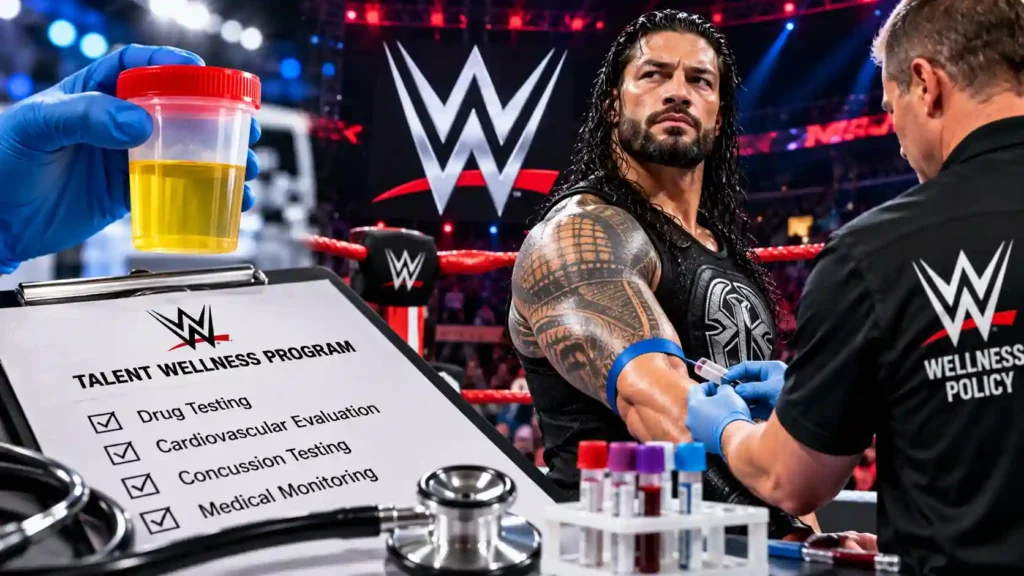
When a WWE superstar suddenly disappears from television for 30 or 60 days without an on-screen storyline or an announced injury, fans start asking the same question: how does WWE wellness policy work, and is that missing performer serving a suspension under it? That governing document, formally known as the WWE Talent Wellness Program, is exactly where the answer usually lies.
Originally introduced to modernize athlete safety and establish formal medical oversight, the policy remains one of the most scrutinized corporate documents in professional wrestling. Beyond the headline-grabbing suspension notices, the program governs a comprehensive network of cardiovascular testing, concussion management protocols, and independent toxicology screenings.
Here is the breakdown of how the program was established, how random testing is administered, how the three-strike disciplinary system operates, and the medical evaluations required for talent.
The Origins of the Talent Wellness Program
During the early 1990s, the World Wrestling Federation (WWF) maintained strict steroid testing amid federal scrutiny, but comprehensive independent screening waned as industry competition intensified over the following decade.
After a period of growing concern regarding performer health and cardiovascular longevity, WWE announced the development of a comprehensive new health initiative in late 2005. The company officially implemented its formal Talent Wellness Program on February 27, 2006.
Rather than functioning solely as a punitive drug test, the program was structured as an ongoing medical surveillance framework supervised by independent medical professionals, combining regular substance evaluations with baseline internal health monitoring.
Independent Drug Testing and Substance Enforcement

WWE’s substance abuse and drug testing policy is independently administered by Aegis Sciences Corporation, a forensic toxicology and healthcare laboratory. Performers are subject to unannounced, random drug testing throughout the calendar year, with WWE’s official disclosures noting an average minimum of four random tests per performer annually.
The program categorizes violations and substances through specific regulatory guidelines:
1. Performance-Enhancing Substances and Anabolic Agents
The policy strictly prohibits non-medical use of anabolic androgenic steroids, peptide hormones, human growth hormone (hGH), and synthetic testosterone. It also bans masking agents such as prescription diuretics, which can be abused to cut water weight quickly or dilute testing samples.
2. Prescription Medications and Banned Muscle Relaxers
Prescription drugs—including pain medications, sedatives, and muscle relaxers—require verifiable, legitimate medical authorization from a licensed treating physician. However, certain substances with a documented history of severe abuse, most notably Carisoprodol (Soma), are explicitly banned under the policy regardless of whether a talent holds an outside prescription.
3. Recreational Substances and Alcohol
- Illicit Narcotics: Street drugs including cocaine, heroin, and methamphetamine represent direct violations of the policy.
- Alcohol: WWE’s Wellness Program addresses substance abuse and alcohol-related concerns, but the publicly available WWE FAQ does not provide detailed information about a specific arena breathalyzer procedure.
- Marijuana: WWE’s published Talent Wellness Program documentation states that a positive test for marijuana results in a $2,500 fine per positive test. The policy treats cannabis metabolites distinctly, handling them through financial penalties rather than the standard three-strike suspension structure. While this fine remains officially listed on WWE’s policy, multiple 2022 wrestling media reports indicate the company has quietly stopped enforcing it in practice in recent years.
Also Read-: Undertaker vs Shawn Michaels WrestleMania 25: The Anatomy of a Classic
The Three-Strike System: Suspensions and Penalties
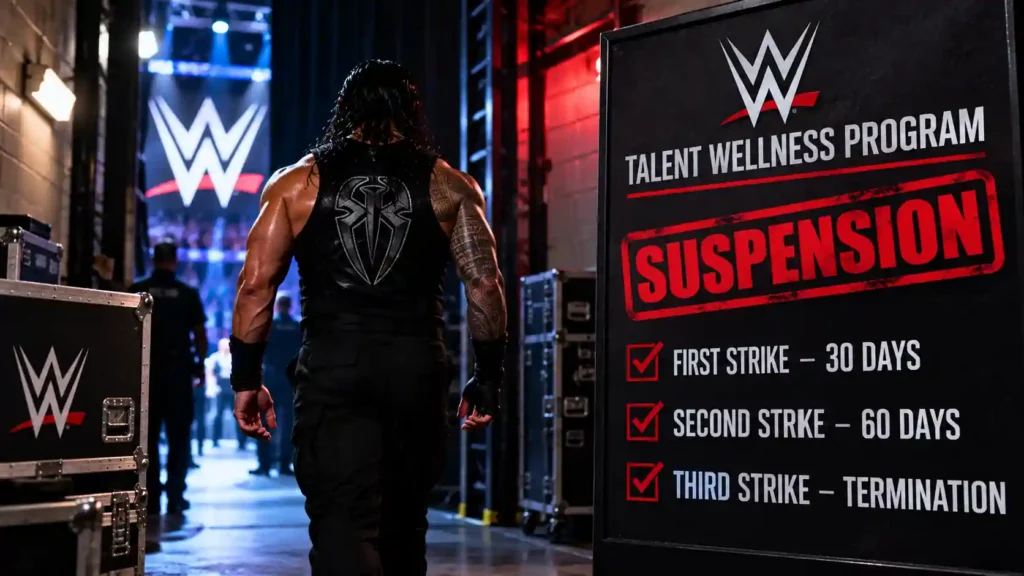
For non-marijuana substance violations, WWE enforces a formal three-strike disciplinary progression. When an unexcused positive test is confirmed by the program administrator, the disciplinary process is applied according to the policy:
| Violation Tier | In-Ring Suspension & Pay | Disciplinary Outcome & Announcement |
|---|---|---|
| First Strike | 30-day suspension without pay | Performer’s name and suspension length publicly announced |
| Second Strike | 60-day suspension without pay | Performer’s name and suspension length publicly announced |
| Third Strike | Immediate contract termination | Performer’s name and contract termination publicly released |
Follow-Up Testing Protocol
A strike carries ongoing monitoring requirements. According to WWE’s official policy disclosures, any performer who incurs a positive test violation is placed into an intensified testing protocol, requiring them to undergo at least 12 unannounced follow-up drug tests over the subsequent one-year period.
Valid Prescriptions vs. Medical Exemptions
WWE’s Substance Abuse and Drug Testing Policy does not utilize a traditional “Therapeutic Use Exemption” (TUE) committee structure found in Olympic combat sports. Instead, the policy handles legitimate medical needs through a direct physician review process:
- If a performer tests positive for a controlled or restricted substance, they must provide verifiable documentation of a valid prescription issued by a licensed treating physician for a diagnosed medical condition.
- WWE’s Medical Director, in direct consultation with the Program Administrator, investigates the medical necessity, dosage, and diagnostic records behind the prescription. WWE’s official disclosures note that fewer than 4% of active talent hold approved therapeutic exceptions at any given time.
- Prescriptions obtained through online consultations, unverified anti-aging clinics, or medical providers operating outside customary clinical practices are not accepted as legitimate authorization.
Also Read-: 9 Real Weapons WWE Superstars Actually Use in the Ring
Cardiovascular Monitoring and Concussion Protocols
Beyond substance testing, a central pillar of the Talent Wellness Program is physical longevity and preventive care:
- Cardiovascular Evaluations: Because professional wrestling places chronic physical strain on the heart, the program mandates regular cardiovascular evaluations and annual physicals. These diagnostics are designed to detect underlying heart abnormalities, arterial risks, or early signs of cardiomyopathy before a performer enters the ring.
- ImPACT Concussion Management: WWE utilizes the ImPACT (Immediate Post-Concussion Assessment and Cognitive Testing) program to monitor brain function. Superstars complete baseline testing covering memory, processing speed, and neurocognitive reaction times. If an athlete sustains a suspected concussion during an event, they are removed from in-ring action and cannot return until they pass follow-up ImPACT evaluations and secure clinical clearance from a certified physician.
Also Read-: WWE Intercontinental Championship History: Legacy, Greatest Champions & Evolution
The Long-Term Impact on Professional Wrestling
While public debates occasionally emerge regarding testing logistics, the establishment of the WWE Talent Wellness Program marked a definitive shift away from the unmonitored eras of professional wrestling.
By pairing independent toxicology screening from Aegis Sciences Corporation with regular cardiovascular testing, baseline concussion protocols, and mandatory follow-up testing schedules, the program remains WWE’s internal framework for addressing talent health, substance testing, and related medical monitoring.
Sources & Reference Records

About Gaurav Sharma
I am the founder, lead writer, and editor behind Wrestling Nightmare. I have been analyzing and following professional wrestling for years, with a deep focus on WWE, AEW, and TNA—spanning the Attitude Era, the Ruthless Aggression transition, and modern long-term booking eras like The Bloodline. My work centers on breaking down in-ring storytelling, creative booking decisions, and the business landscape of combat sports entertainment. When I am not breaking down pay-per-view match structures, I am tracking roster movements, injury reports, and backstage creative pivots to deliver grounded, hype-free pro wrestling analysis.
contact@wrestlingnightmare.com