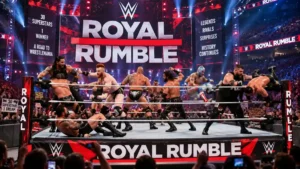

Why WWE banned blood is a question fans still argue about. For years, a bloody forehead was part of how wrestling told a big story. Then, around 2008, it mostly vanished from WWE television.
There is no single announcement that says “blood is banned.” The change came from several things happening around the same time. This article covers what the public record shows, and where it only gives us context.
Safety note: This is a history article, not a how-to. Intentionally cutting yourself is dangerous, and this article will not describe how planned bleeding was done.
Blood Used to Be Part of the Show
Through the territory days and the Attitude Era, fans expected to see wrestlers bleed in major matches. Fans call planned bleeding “blading,” and it was a normal storytelling tool. A feud felt more serious when it left a mark.
WWE’s programming matched that tone. According to Wikipedia’s PG Era timeline, Raw moved to a TV-14 rating in 1999 during the Monday Night War and stayed there until 2008. SmackDown carried a TV-PG rating from the start.
If you want to see how wrestling’s rougher side evolved, our Attitude Era breakdown covers it.
The Match That Showed the Medical Risk
The best-known example comes from Judgment Day on May 16, 2004. Eddie Guerrero defended the WWE Championship against John “Bradshaw” Layfield (JBL), and Guerrero bled far more than anyone intended.
Accounts differ on the details. The Wrestling Observer’s report from that week says Guerrero was taken to a hospital, needed 16 stitches, and received IV fluids. Years later, JBL said Guerrero did go to the hospital but never went into shock, which is different from some of the more dramatic versions fans repeated.
Both sides agree on the main point. A planned visual turned into a hospital visit.
Be careful with this example, though. The match happened four years before WWE’s PG rating. WWE never said it was the reason for any rule, so treat it as an example of the risk, not as proof of cause.
The 2007 Fallout
In June 2007, wrestler Chris Benoit’s death in a tragedy involving his family led to a congressional investigation into WWE’s health and safety practices, particularly its drug-testing program. The investigation focused on wellness, not on blood.
Still, it put the whole industry under a spotlight. WWE had every reason to look more careful and more mainstream. That’s context, not a stated reason, but it helps explain why 2008 became the year the product changed.
July 2008: WWE Goes PG
On July 22, 2008, WWE announced that its family programming had been deemed PG by its network distributors, covering Raw, SmackDown, and ECW. A corporate release on July 28 repeated the point, saying every network distributor now rated WWE’s weekly shows PG and that the same standard applied to WWE’s website and publications.
Neither announcement mentions blood. What they did was commit WWE to a family rating, and a family rating didn’t fit planned bleeding.
The business side is easier to see. USA Network’s own look back says WWE was attracting mainstream advertisers, including toy brand Mattel. By 2013, WWE reported that revenue had nearly tripled since the move to TV-PG, thanks to partnerships with companies like Mattel and Post Cereals, as Wikipedia notes. During that same stretch, TV ratings declined, so the picture isn’t simple.
Planned blood faded out. So did heavy profanity and some of the most violent imagery. Chair shots to the head were later restricted too, which we explain in our piece on why WWE banned chair shots to the head.
What About Accidental Blood?
Real injuries still happen. USA Network’s explainer notes that blood can still appear by accident, and when it does, medical staff check on the wrestler. That’s a medical response, not a storyline choice.
Other promotions have followed different rules at different times. A looser standard somewhere else doesn’t make the practice safe, and it doesn’t change what WWE does.
Frequently Asked Questions
Did WWE officially ban blood?
Not in a single announcement. The July 2008 PG announcement set a family-friendly standard, and planned bleeding stopped appearing on WWE television after that.
When did blood disappear from WWE?
Most sources point to 2008. WWE announced its PG rating on July 22, 2008, and SummerSlam 2008 was the first pay-per-view under that rating, according to Wikipedia.
Is WWE still PG?
Most of its programming is still TV-PG. Raw was reported to be moving back to TV-14 in July 2022. Check current WWE news for the latest, since this article covers the 2008 change.
Was the Guerrero match the reason for the rule?
No source says so. It’s a widely cited example of the medical risk, but it happened years before the PG rating.
Final Thoughts
So why did WWE ban blood? The honest answer is a mix of advertisers, a family-friendly rebrand, and a company under pressure to look responsible after 2007. WWE never said it in those words. For more on how the product changed, read our WWE news coverage and our look at the most dangerous wrestling botches.
Sources
- WWE.com: WWE goes PG (July 22, 2008)
- WWE corporate release: WWE Rated PG (July 28, 2008)
- Wikipedia: PG Era
- USA Network: Why blood is banned in WWE
- Wrestling Observer, May 24, 2004 (via F4W)
- WrestleZone: JBL on the Guerrero match
- WrestleZone: congressional investigation coverage
- Last Word on Sports: Raw TV-14 report

About Gaurav Sharma
I am Gaurav Sharma, founder and the only writer at Wrestling Nightmare. I live in Punjab, India. I have watched professional wrestling since 2000, and for the last 15 years I have followed dirtsheet reporting and the difference between what is shown on screen and what is reported from backstage. I write explainers and labeled opinion on WWE, AEW, and TNA. I credit the outlet that broke a story, and I do not publish unsourced salary figures or private family pieces.
contact@wrestlingnightmare.com