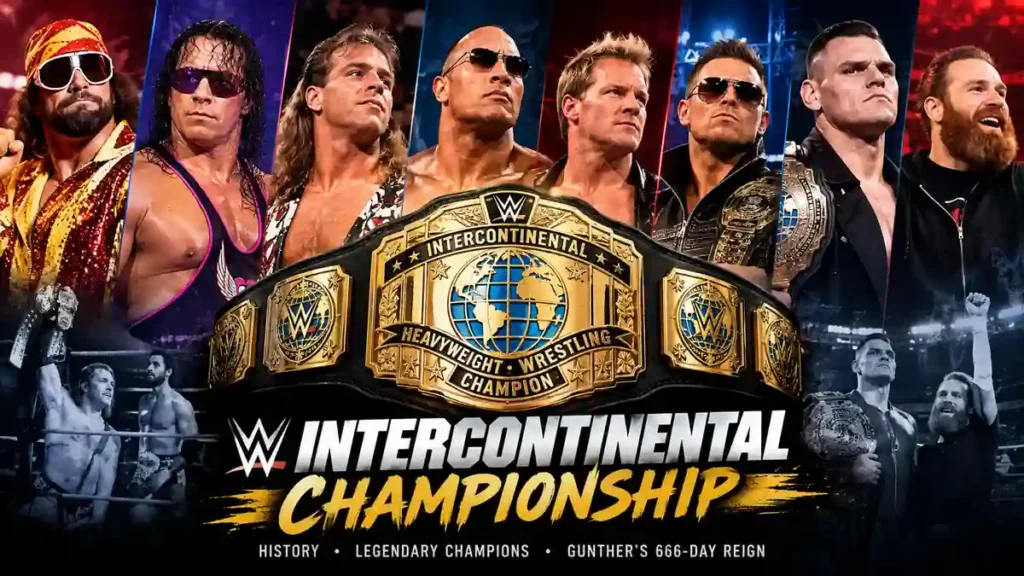
In professional wrestling, world championships carry the company’s corporate spotlight and the final promotional billing. Yet for decades, purists and dedicated followers have looked toward a different prize to gauge in-ring athletic excellence: the WWE Intercontinental Championship. Examining the full WWE Intercontinental Championship history reveals why this title earned its enduring reputation as the industry’s ultimate “workhorse” belt. While the World Heavyweight Champion was often the charismatic showman tasked with driving mainstream ticket sales, the Intercontinental Champion was expected to deliver the match of the night, night after night, regardless of the size of the crowd or the card position. The title’s trajectory has not been a simple straight line; it experienced golden peaks, a prolonged period of creative stagnation, and eventually a modern renaissance that re-established its status as legitimate main-event gold.
The Golden Era: Establishing the Stepping Stone
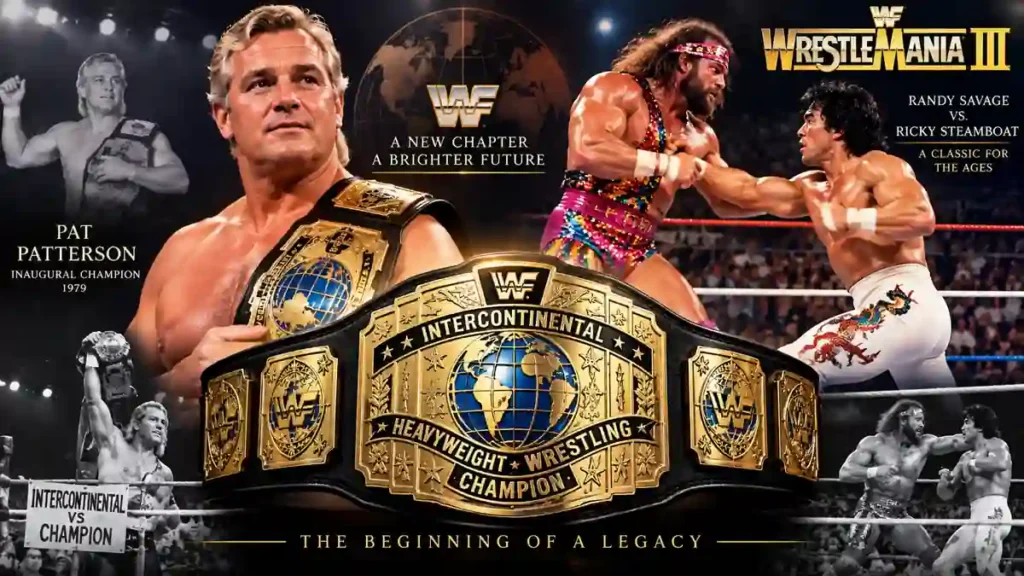
The Intercontinental Title was introduced in September 1979, with WWE Hall of Famer Pat Patterson recognized as the inaugural champion following a fictional tournament storyline in Rio de Janeiro. The backstory was theatrical fiction, built around a supposed unification with an invented South American title, but the in-ring standard was set immediately, and it stuck.
During the late 1980s and early 1990s, the championship evolved into a proving ground for performers transitioning toward main-event status:
- Randy Savage vs. Ricky Steamboat (WrestleMania III): While Hulk Hogan slamming André the Giant provided the spectacle, Savage and Steamboat’s tightly choreographed 15-minute contest set an enduring benchmark for mid-card athletic workrate that wrestlers still study today.
- The Ultimate Challenge (WrestleMania VI): When Intercontinental Champion The Ultimate Warrior faced WWF Champion Hulk Hogan, it marked a rare instance where WWE placed both titles on the line in the main event of their flagship show, proving the secondary champion could headline a stadium crowd on equal commercial footing. Warrior won the WWF Championship that night, and the Intercontinental belt was vacated shortly after, with Mr. Perfect winning the subsequent tournament.
- Bret Hart vs. British Bulldog (SummerSlam 1992): Main eventing Wembley Stadium in front of over 80,000 spectators, this match proved that a personal, emotionally driven secondary title program could close a major stadium event without a world championship anywhere near the card.
Performers such as Shawn Michaels, Razor Ramon, and Stone Cold Steve Austin subsequently used the Intercontinental title scene to refine their match pacing and promo delivery before entering the world championship picture. Even Chyna carved out history here, becoming the only woman to hold the title after beating Jeff Jarrett at No Mercy in 1999 — a reminder that the belt’s lineage has never been entirely conventional.
Also Read-: Beyond the Powerhouse: 7 Lesser-Known Facts About Royce Keys’ Journey to WWE
The Mid-Card Slump: Inconsistent Booking and Diminished Value
As WWE navigated the Ruthless Aggression and PG Eras, the championship suffered from inconsistent creative focus. Following the WWF’s 2001 purchase of WCW, the title was folded into a messy unification period: it absorbed the WCW United States Championship at Survivor Series, and by mid-2002 it had also been merged with the European and Hardcore Championships in a chaotic series of ladder and gauntlet matches. The company briefly deactivated the title before reactivating it, often treating it as a decorative prop rather than an ongoing narrative anchor.
The central issue during the late 2000s and 2010s was high title turnover paired with frequent non-title losses on weekly television. When champions routinely dropped non-title matches on Monday Night Raw simply to construct last-minute pay-per-view contenders, the title’s prestige diminished with every broadcast.
Veterans like The Miz, Dolph Ziggler, and Cody Rhodes still delivered standout individual runs during this stretch — The Miz’s impassioned 2016 Talking Smack promo defending the title’s honor remains a fan-favorite moment — but creative direction rarely afforded the championship consistent long-term storytelling. It became a title wrestlers could shine with in isolated bursts, not one that shaped a roster’s hierarchy.
Also Read-: Why Penta Holds Up 3 Fingers in Cero Miedo Hand Sign
The Modern Renaissance: How Gunther Rewrote History
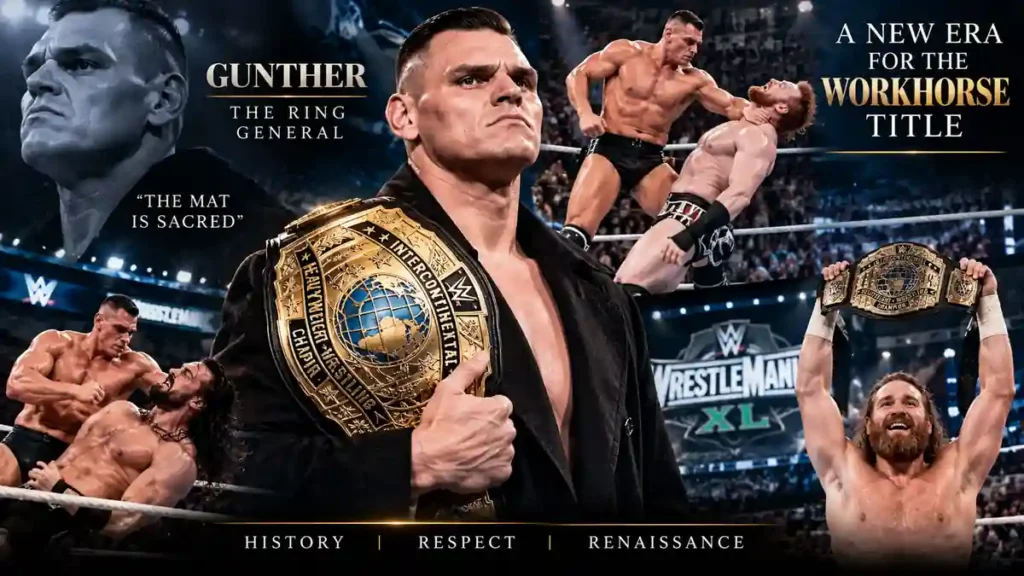
The turning point for the Intercontinental Championship came with Gunther’s rise under the creative direction of Paul “Triple H” Levesque.
Gunther won the championship from Ricochet on the June 10, 2022 episode of SmackDown, just weeks after his main roster call-up from NXT. He anchored his run on hard-hitting, physical realism. His European wrestling ethos — “The mat is sacred” — became the stylistic identity of the entire division.
Key Factors Behind the Historic Reign
Gunther’s reign became the longest Intercontinental Championship run in WWE history, surpassing the 35-year-old record of 454 days previously held by The Honky Tonk Man. He officially broke that record on September 7, 2023, and kept building from there:
- Physical Storytelling: High-profile defenses against Sheamus, Drew McIntyre, Rey Mysterio, Shinsuke Nakamura, and Braun Strowman were widely praised for their hard-hitting realism and clean structure. His triple threat with McIntyre and Sheamus at WrestleMania 39 is regarded as one of the best matches in the event’s modern history.
- Elevated Card Placement: The championship regularly closed weekly television broadcasts and anchored premium live events rather than sitting on the undercard.
- Decisive Finishes: Avoiding cheap disqualifications or heavy outside interference, Gunther won through decisive physical dominance, which raised the perceived difficulty of ever taking the belt off him.
When Sami Zayn finally ended the reign at WrestleMania 40 on April 6, 2024 in Philadelphia — hitting a top-rope brainbuster followed by two Helluva Kicks after a grueling 15-minute war — the victory carried the emotional weight of a world title transition. The championship had been protected for nearly two full years, and Zayn’s win instantly felt like a career-defining moment rather than a routine title change.
Also Read-: 10 Things You Didn’t Know About Danhausen
Where the Title Stands Today
The championship has continued to change hands in the years since Gunther’s reign ended, cycling through champions including Sami Zayn, Bron Breakker, and Jey Uso. As of August 2, 2026, Chad Gable holds the title after defeating Penta on Night 2 of SummerSlam, keeping the workhorse tradition alive with a champion known for grinding, technical matches rather than spectacle.
Eras of the Intercontinental Championship
| Era | Defining Champions | In-Ring Style & Identity | Creative Significance |
| The Golden Era (1980s–1990s) | Randy Savage, Bret Hart, Shawn Michaels | Technical fundamentals, fast pacing, workrate focus | The foundational stepping stone to the World Heavyweight Title |
| Attitude & Ruthless Aggression Eras | The Rock, Chris Jericho, Edge, Christian | High-tempo, storyline-heavy, weapon integration | High title turnover; secondary focus behind main factions |
| The Inconsistent Slump (2010–2020) | The Miz, Dolph Ziggler, Big E | Character-driven promos, varied weekly booking | Frequent non-title television losses; short programs |
| The Modern Era (2022–Present) | Gunther, Sami Zayn, Jey Uso, Chad Gable | Physical realism, tournament formats, protected finishes | Major PLE spotlight and occasional main-event positioning |
Why the Title Remains Vital to WWE’s Long-Term Roster Health
In an era featuring two world championships across separate brands, the Intercontinental Championship provides essential editorial balance for WWE’s weekly storytelling:
- Distinct Match Presentation: World title angles frequently rely on long cinematic segments, while the Intercontinental title emphasizes pure match structure, tournament brackets, and technical counters.
- A Roster Litmus Test: The division remains an effective barometer for rising stars — Bron Breakker, Chad Gable, and Jey Uso among them — to prove they can hold viewer interest across demanding 15-to-20-minute television matches.
- International Appeal: Defended regularly on overseas premium live events across Europe and Australia, the title serves as an international calling card for pure in-ring wrestling, independent of the language barrier a heavy promo-driven world title program can create.
Final Thoughts
A championship belt is ultimately an inanimate prop; its perceived value depends entirely on how performers and writers treat it on screen. WWE’s booking since 2022 has returned the championship to its traditional strengths: competitive clean finishes, long-form rivalries, and an emphasis on pure in-ring ability.
By re-establishing athletic credibility, the Intercontinental Championship reclaimed its place as one of the most respected titles in professional wrestling, and Gunther’s 666-day masterclass will likely be the measuring stick every future champion gets compared against.
Reference Links (Authoritative Sources)
- WWE Official Intercontinental Championship Title History
- Intercontinental Championship Lineage & Origin Details
- CBS Sports: Gunther Breaks Historic Intercontinental Title Record
- Wrestling Inc: Sami Zayn Dethrones Gunther at WrestleMania 40

About Gaurav Sharma
I am the founder, lead writer, and editor behind Wrestling Nightmare. I have been analyzing and following professional wrestling for years, with a deep focus on WWE, AEW, and TNA—spanning the Attitude Era, the Ruthless Aggression transition, and modern long-term booking eras like The Bloodline. My work centers on breaking down in-ring storytelling, creative booking decisions, and the business landscape of combat sports entertainment. When I am not breaking down pay-per-view match structures, I am tracking roster movements, injury reports, and backstage creative pivots to deliver grounded, hype-free pro wrestling analysis.
contact@wrestlingnightmare.com