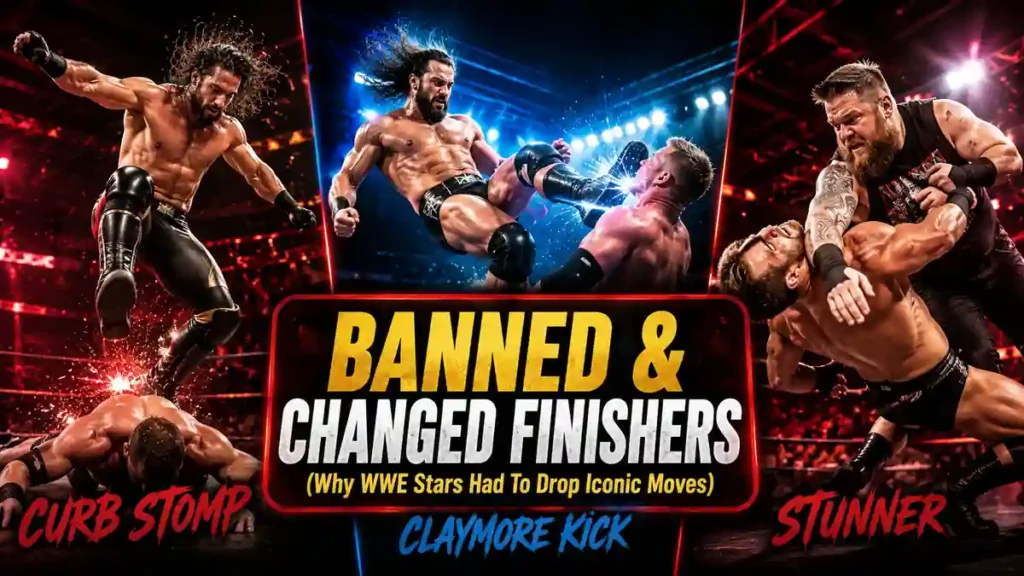
Every professional wrestler has one signature weapon that defines their career: the finishing move. When it connects, the crowd erupts, knowing the three-count or submission is inevitable.
Over the years, a great finisher becomes a superstar’s brand—featured in video packages, video game covers, and action figures. But WWE history proves that even the most protected moves aren’t set in stone.
Sometimes a finisher is banned over legitimate concussion and safety concerns. Sometimes a wrestler adopts a new hold to match an evolving character. And in rare cases, a wardrobe mishap mid-match turns an accident into an iconic finisher.
Here is the true, backstage story behind 10 WWE Superstars who changed their iconic finishing moves and why those changes happened.
Quick Summary: Iconic Finisher Changes in WWE
| Superstar | Original / Former Finisher | Replaced With / Added | Primary Reason for Change |
| Seth Rollins | Curb Stomp | Pedigree / Ripcord Knee (Stomp returned) | Banned by Vince McMahon due to violent PR optics |
| Kevin Owens | Pop-Up Powerbomb | Stone Cold Stunner | Powerbomb oversaturation; personally approved by Steve Austin |
| Randy Orton | The Punt Kick | RKO (Punt saved as lethal weapon) | Banned due to real-life concussion and head trauma risks |
| AJ Styles | Styles Clash | Phenomenal Forearm / Calf Crusher | Temporarily restricted over past neck injury concerns |
| Roman Reigns | The Spear | Added Guillotine Choke | Adapted to match ruthless “Tribal Chief” heel character |
| The Miz | Reality Check | Skull-Crushing Finale | Needed a versatile facebuster that worked on any body size |
| Drew McIntyre | Future Shock DDT | The Claymore Kick | Created by accident to avoid ripping tight leather pants |
| CM Punk | Anaconda Vise | Go To Sleep (GTS) | Wanted a high-impact, sudden strike for top-tier main events |
| Sheamus | Celtic Cross | Brogue Kick | Shifted to a faster, out-of-nowhere big boot knockout |
| Bray Wyatt | Sister Abigail | Mandible Claw (The Fiend era) | Adopted from Mick Foley to amplify psychological horror |
1. Seth Rollins — Curb Stomp to Pedigree and back again
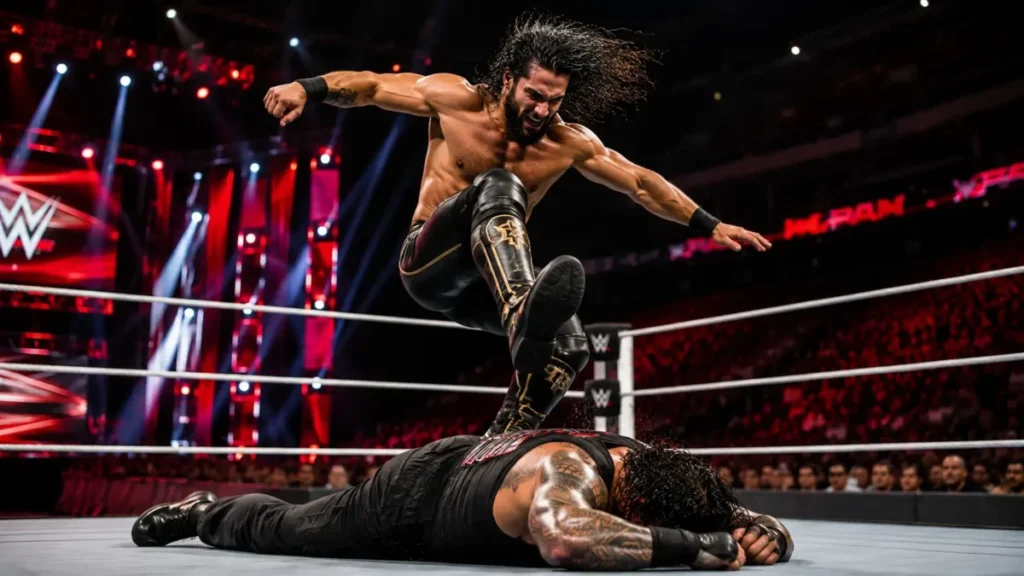
Seth Rollins pulled off the “Heist of the Century” at WrestleMania 31 by hitting the Curb Stomp to win his first WWE Championship. But within 24 hours, the move vanished from WWE television.
Rollins later revealed that Vince McMahon saw the maneuver highlighted on The Today Show while Rollins was doing media appearances in a sharp corporate suit. McMahon felt the image of his top champion stomping an opponent’s head into the canvas was too violent and carried negative real-world connotations.
Rollins spent months trying alternatives—including the Ripcord Knee and Triple H’s Pedigree (fitting his Authority storyline). In 2018, after years of pitching, Rollins finally convinced management to bring it back simply as “The Stomp.”
2. Kevin Owens — Pop-Up Powerbomb to Stunner
For years across the independent circuit as Kevin Steen and throughout his early WWE run, Owens dismantled opponents with the Pop-Up Powerbomb.
By 2019, however, Owens felt the powerbomb had become oversaturated across wrestling, losing its special, match-ending mystique. Wanting a finisher that created instantaneous crowd pop, Owens reached out directly to “Stone Cold” Steve Austin to ask for permission to use the Stunner.
Austin gave his blessing immediately. The move fit Owens’ rebellious, anti-authority babyface run perfectly, especially during his high-profile rivalry against Shane McMahon.
📌 Must Read: WWE Superstars Who Refused to Do the Job: The Biggest Backstage Battles Ever
3. Randy Orton — The Punt Kick gets banned
During the peak of his ruthless “Age of Orton” heel run, Randy Orton’s Punt Kick was the most dreaded attack in WWE. It was booked to give superstars storyline concussions and months-long hospitalizations.
However, during WWE’s transition into the PG era and increased awareness surrounding concussions, WWE officially banned the Punt Kick in 2012. Because the kick relied on full-force momentum toward a grounded opponent’s head, the risk of real concussion trauma was too severe for regular television.
Orton focused entirely on the RKO as his primary finisher, saving the Punt Kick exclusively for rare, high-stakes story moments.
4. AJ Styles — Styles Clash sidelined at first
When AJ Styles made his legendary debut at the 2016 Royal Rumble, fans expected the Styles Clash to finish his matches. Instead, Styles relied on the Phenomenal Forearm and Calf Crusher.
WWE had initially put restrictions on the move. In previous promotions, a few opponents had suffered severe neck injuries when they instinctively tucked their chins downward instead of throwing their heads back.
It wasn’t until veteran Chris Jericho personally vouched for Styles and volunteered to take the move on television that Vince McMahon gained full confidence in its safety, allowing Styles to use it regularly.
📌 Also Read:Roman Reigns Is Unquestionably the Greatest Heel in WWE History
5. Roman Reigns — Adding the Guillotine Choke
The Spear and Superman Punch were the explosive hallmarks of Roman Reigns’ babyface tenure. But when Reigns returned at SummerSlam 2020 as The Tribal Chief, he needed an arsenal that reflected cold, calculating dominance.
Reigns introduced the Guillotine Choke, a brutal submission that choked opponents unconscious rather than just pinning them. It gave Reigns unmatched versatility: he could run through an opponent with a Spear or slowly extinguish their will to fight with the Guillotine.
6. The Miz — Reality Check to Skull-Crushing Finale
Early in his singles career, The Miz utilized the Reality Check (a running knee lift into a neckbreaker). While flashy, it lacked the sudden, impactful snap required of a future world champion.
Working backstage alongside legends Dean Malenko and Arn Anderson, Miz tested multiple concepts before settling on a full-nelson leg-sweep facebuster—dubbed the Skull-Crushing Finale. Miz noted its greatest strength is universal versatility: unlike powerbombs or suplexes, it can be executed safely on anyone from Rey Mysterio to The Undertaker.
7. Drew McIntyre — An accident becomes the Claymore Kick
Before becoming the “Scottish Warrior,” Drew McIntyre used the Future Shock DDT. The finisher that defined his main-event resurgence, however, was born from a complete wardrobe accident in 2013 during his 3MB days.
Wearing extremely tight leather pants during a tag match, McIntyre charged for a standard big boot. Mid-leap, he felt his pants about to split down the middle. To prevent an embarrassing wardrobe malfunction on live TV, he instinctively thrust his other leg into the air.
The resulting double-leg flying kick looked so vicious that backstage producers told him to refine it immediately. It became the Claymore Kick, the devastating strike that propelled him to two WWE Championships.
8. CM Punk — Anaconda Vise to Go To Sleep
When CM Punk arrived in ECW and WWE, his primary weapon was the Anaconda Vise, an arm-triangle submission hold.
As Punk rose toward main-event status, he wanted an explosive, sudden-impact strike that could finish matches on pay-per-view in dramatic fashion. He adapted the Go To Sleep (GTS)—a fireman’s carry lifted into a knee strike to the face, originally created by Japanese star KENTA. The GTS became synonymous with Punk’s historic 434-day WWE Championship reign.
📌 Must Read:10 Former WWE Superstars Who Found Massive Success in TNA Wrestling
9. Sheamus — Celtic Cross to Brogue Kick
During his initial WWE arrival, Sheamus dominated opponents with the Celtic Cross (a high-angle crucifix powerbomb) and the Irish Curse backbreaker.
Wanting a knockout blow that could be executed in a split-second from anywhere in the arena, Sheamus introduced the Brogue Kick. The running bicycle kick became one of the most protected and believable strikes in wrestling history, famously ending Daniel Bryan’s World Heavyweight Championship defense at WrestleMania 28 in just 18 seconds.
10. Bray Wyatt — Sister Abigail to the Mandible Claw
Throughout the Wyatt Family era, Bray Wyatt put opponents away with Sister Abigail, a theatrical swinging reverse STO that embodied the eerie mystique of the swamp-cult leader.
When Wyatt reinvented himself in 2019 as The Fiend, the character required something far more disturbing. Wyatt adopted the Mandible Claw, paying homage to Mick Foley while using it as a tool of pure psychological and physical asphyxiation. It perfectly bridged the gap between wrestling theater and genuine horror.
❓ Frequently Asked Questions (FAQ)
Why was Seth Rollins’ Curb Stomp originally banned in WWE?
Vince McMahon banned the Curb Stomp in 2015 after seeing it in a Today Show media package, worrying that stomping an opponent’s head into the mat was too violent for WWE’s top corporate champion.
Did Steve Austin give Kevin Owens permission to use the Stunner?
Yes. Kevin Owens personally asked Steve Austin for his blessing before adopting the Stunner in 2019, which Austin granted without hesitation.
How did Drew McIntyre invent the Claymore Kick?
The Claymore was created by accident during a 2013 match. McIntyre was wearing tight leather pants that were about to split during a big boot attempt, forcing him to kick up his second leg to avoid a wardrobe malfunction.
Final Thoughts
A wrestler’s finisher is never just a move—it is the exclamation point on their story. Whether adapting to injuries, corporate bans, or accidental flashes of brilliance, these 10 superstar transformations proved that changing a finisher can be the exact catalyst needed to create a Hall of Fame legacy.

About Gaurav Sharma
I am the founder, lead writer, and editor behind Wrestling Nightmare. I have been analyzing and following professional wrestling for years, with a deep focus on WWE, AEW, and TNA—spanning the Attitude Era, the Ruthless Aggression transition, and modern long-term booking eras like The Bloodline. My work centers on breaking down in-ring storytelling, creative booking decisions, and the business landscape of combat sports entertainment. When I am not breaking down pay-per-view match structures, I am tracking roster movements, injury reports, and backstage creative pivots to deliver grounded, hype-free pro wrestling analysis.
contact@wrestlingnightmare.com