
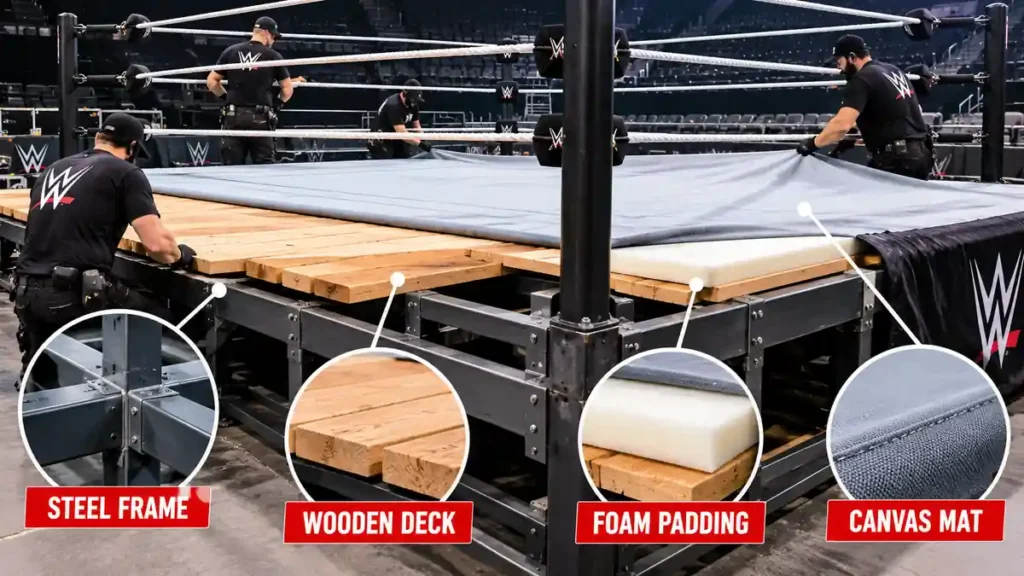
If you’ve only ever seen a WWE ring on TV, it’s easy to assume there’s something soft under that canvas — maybe a trampoline, maybe a mattress. That’s not the case. A wrestling ring looks bouncy on camera, but it’s actually a hard, heavy, carefully engineered stage. Wrestlers who take a flat-back bump still feel real impact, even with all the padding underneath. So how are WWE rings built, exactly? It comes down to five layers working together: steel framing, wooden planks, foam padding, canvas, and tensioned ropes. WWE keeps its exact blueprints private, but ring crew members and builders have talked about the general design for years. Here’s how WWE rings are built, step by step.
1. The Steel Frame Underneath
Every ring starts with a steel skeleton. It’s not one solid welded structure — it’s built from separate steel pieces that bolt together, which is what lets crews set it up and tear it down quickly on tour.
- Size: WWE’s ring is built at a standard 20-foot by 20-foot size, according to longtime WWE ring builder Kevin “Doc” Carpenter. Some indie and regional promotions use smaller 16 or 18-foot rings instead.
- Corner posts: Four thick steel posts sit at the corners and take most of the pulling force from the tensioned ropes.
- Support beams: Steel crossbeams run across the frame, with extra beams through the middle so the floor doesn’t cave in when multiple wrestlers land at once.
2. The Wooden Floor
A lot of fans assume the ring floor is one big sheet of plywood. It isn’t — a single thin sheet would crack under the weight of a wrestler landing from height.
Instead, builders lay down individual wood planks side by side across the steel frame:
- Thick boards: Usually heavy lumber, similar to 2×10 or 2×12 planks.
- Some natural give: Because the planks aren’t bonded into one solid piece, each one flexes slightly on impact, which helps spread out the force instead of concentrating it in one spot.
- That “boom” sound: The loud thud you hear during a big slam comes from these wood boards vibrating against the steel frame underneath.
3. Is There a Spring Under the Ring?
This is one of the most common questions fans ask, and the answer is no — not the way people imagine it.
- No trampoline springs. A ring with too much bounce would be dangerous — wrestlers running the ropes could easily lose their footing.
- Framing does the work, not springs. Older rings sometimes used a center spring mechanism, but most modern rings rely on the wood and steel structure itself to absorb impact.
- Center vs. edges: The middle of the ring gives a little more because the boards have room to flex. The apron area near the edges is much harder to land on, since it sits directly over solid steel beams with almost no flex.
4. Padding and Canvas
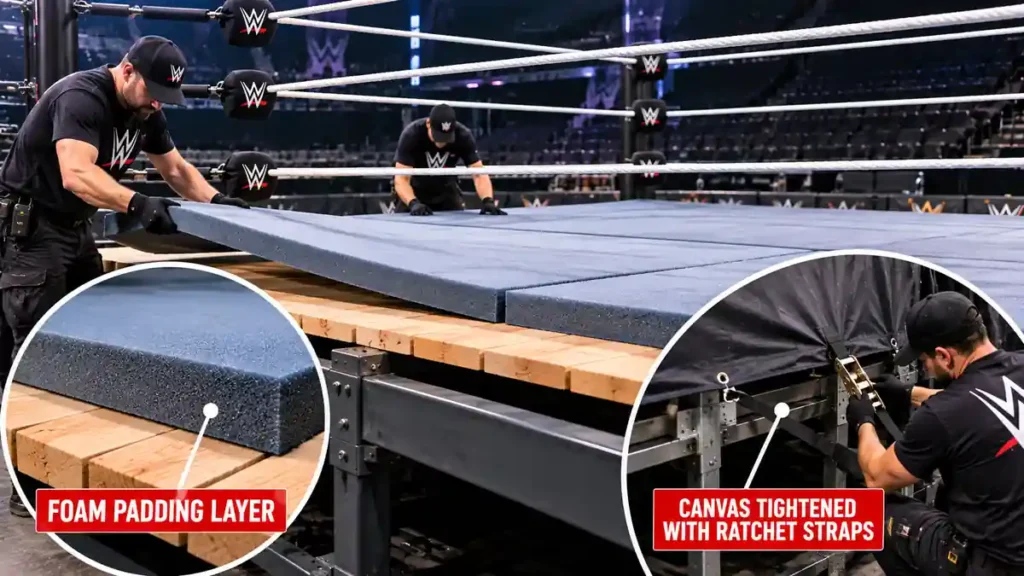
Once the wood decking is down, the crew adds the layers wrestlers actually touch:
- Foam padding: A dense, closed-cell foam layer, usually around 1 to 1.5 inches thick. It’s firm enough that it won’t sink under normal foot traffic, but it takes the hardest edge off a fall.
- Canvas cover: A heavy canvas or vinyl sheet goes over the foam.
- Tie-downs: The canvas gets pulled tight and secured underneath with ropes or straps. If it’s loose, it creates wrinkles that wrestlers can trip on.
5. Rope Type: Fiber vs. Steel Cable
Not every promotion uses the same kind of rope.
- WWE: Uses twisted fiber (or hemp-style) rope wrapped in colored tape. It has natural give, which helps absorb momentum and reduces rope burn.
- Other promotions: Companies like the old WCW, along with many independent promotions, use braided steel cable wrapped in rubber hose instead. Cable holds tension well but has almost no give — it’s a stiffer, more jarring landing.
- Turnbuckles: Steel turnbuckles at each corner let the crew tighten or loosen the ropes so the top rope has the right amount of tension for springboard moves.
6. Setting Up the Ring on Show Day
Building the ring for a live show follows a set routine:
- The four steel corner posts go down first, leveled and locked with the perimeter beams.
- Interior support beams are added, then the wood planks go on top to form the floor.
- Foam padding goes over the wood, followed by the canvas, pulled tight and fastened underneath.
- The ropes get strung through the turnbuckles and tensioned.
- Ring skirts, steps, and hidden microphones go in last.
7. What’s Actually Under the Ring?
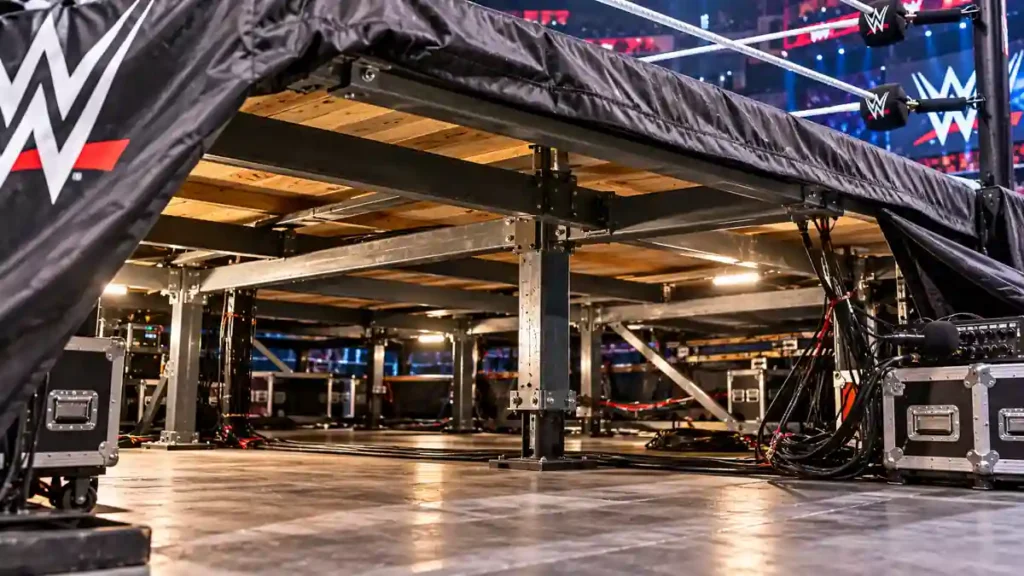
That hidden space under the skirt isn’t just empty air — it’s used for a few things:
- Microphones: Sound techs place mics under the boards to catch the thud of every bump for TV audio.
- Spare gear: Extra turnbuckle pads, tools, and backup canvas are often stored underneath.
- Surprise entrances: Wrestlers have occasionally used the space under the ring for surprise attacks or return segments.
8. Why Wrestlers Still Get Hurt
Even with all this engineering, taking bumps regularly still takes a toll on the body.
- The impact is still real. Foam spreads out the force, but it can’t cancel it out. A flat-back fall from height still sends a shock through the spine, joints, and neck.
- It adds up over time. Wrestlers who compete week after week absorb a huge number of hard landings over a career, which is part of why injuries — including risks tied to weapons in matches — are taken so seriously, and why WWE’s wellness policy exists in the first place.
Ring Comparison Table
| Feature | WWE-Style Ring | Cable Ring (WCW-Style) |
|---|---|---|
| Size | 20 ft x 20 ft | Often 16-18 ft x 16-18 ft |
| Rope type | Twisted fiber rope, wrapped in tape | Steel cable wrapped in rubber hose |
| Floor | Steel frame with wood planks | Steel frame with wood decking |
| Padding | Dense closed-cell foam | Foam or dense felt |
| Feel | More give, deeper sound | Stiffer, more rigid impact |
The Bottom Line
A WWE ring isn’t a soft landing pad — it’s a rigid, purpose-built stage designed to hold up to a touring schedule while still giving wrestlers just enough give to perform safely. Every bump still hurts. The engineering just decides how much.
Sources

About Gaurav Sharma
I am Gaurav Sharma, founder and the only writer at Wrestling Nightmare. I live in Punjab, India. I have watched professional wrestling since 2000, and for the last 15 years I have followed dirtsheet reporting and the difference between what is shown on screen and what is reported from backstage. I write explainers and labeled opinion on WWE, AEW, and TNA. I credit the outlet that broke a story, and I do not publish unsourced salary figures or private family pieces.
contact@wrestlingnightmare.com