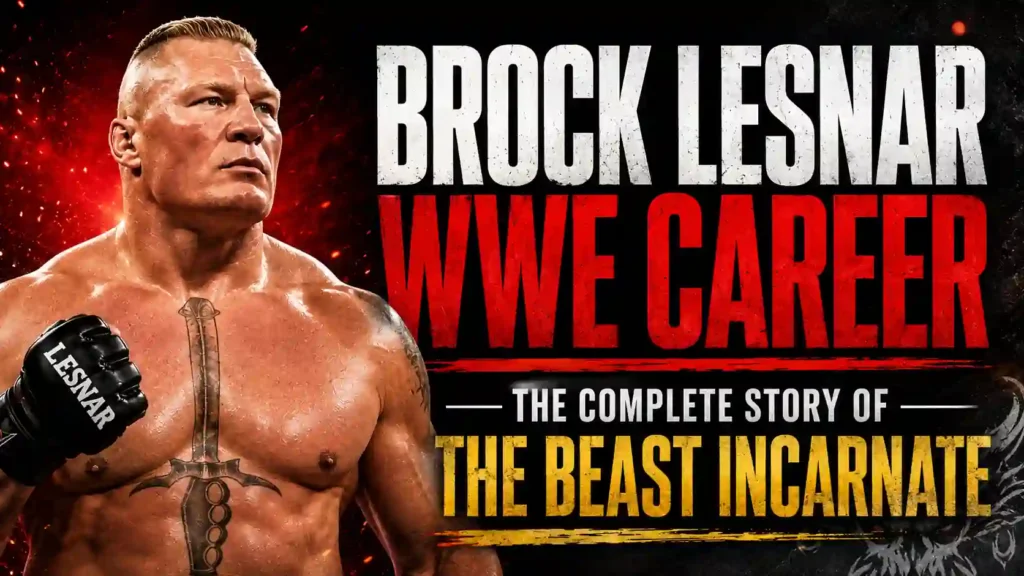
Brock Lesnar’s WWE career does not look like anyone else’s, and that is exactly why it works. From becoming the youngest WWE Champion of his time to winning the UFC Heavyweight Championship and returning as The Beast Incarnate, Lesnar built something you cannot copy just by wrestling more matches. Here’s a complete look at Brock Lesnar’s WWE career, his biggest achievements, and why his story still gets discussed every time he shows up on screen.
Who Is Brock Lesnar?
Brock Lesnar is an American professional wrestler, former UFC Heavyweight Champion, and NCAA Division I wrestling champion. Known as “The Beast Incarnate,” he is a multiple-time WWE World Champion, and to me, he is the closest thing wrestling has had to a genuine unstoppable force since the Attitude Era.
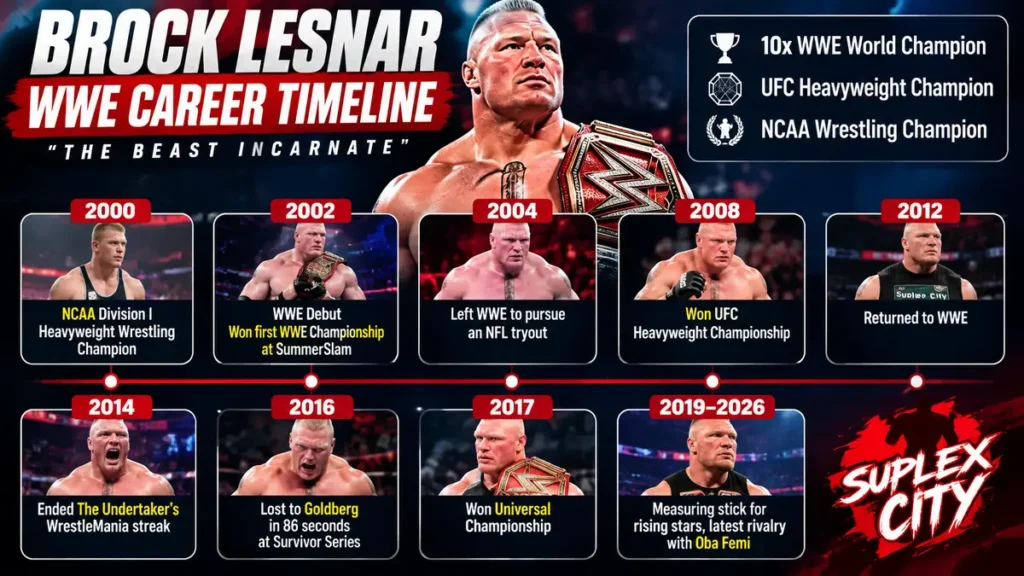
Brock Lesnar Career Timeline
| Year | Achievement |
|---|---|
| 2000 | NCAA Division I Heavyweight Wrestling Champion |
| 2002 | WWE debut |
| 2002 | Won his first WWE Championship at SummerSlam |
| 2004 | Left WWE to pursue an NFL tryout |
| 2008 | Won the UFC Heavyweight Championship |
| 2012 | Returned to WWE |
| 2014 | Ended The Undertaker’s WrestleMania streak |
| 2016 | Lost to Goldberg in 86 seconds at Survivor Series |
| 2017 | Defeated Goldberg to win the Universal Championship |
| 2026 | Rivalry with Oba Femi |
| 2026 | Announced retirement from WWE |
Life Before WWE: A Real Athlete First
Before Brock Lesnar ever stepped into a WWE ring, he was already a serious athlete. He wrestled at the University of Minnesota and won the NCAA Division I heavyweight wrestling championship in 2000, a title that is genuinely brutal to earn in American amateur sports.
This background matters more than most fans realize. A lot of WWE stars learn wrestling moves purely for entertainment and pick up the athleticism later. Lesnar came in the other way around. He already knew real, high-level wrestling before he ever stood in front of a WWE camera, and you could see it in how he moved. That is the part that always separated him for me. His power never looked staged.
Brock Lesnar’s WWE Debut and Early Rise (2002–2004)
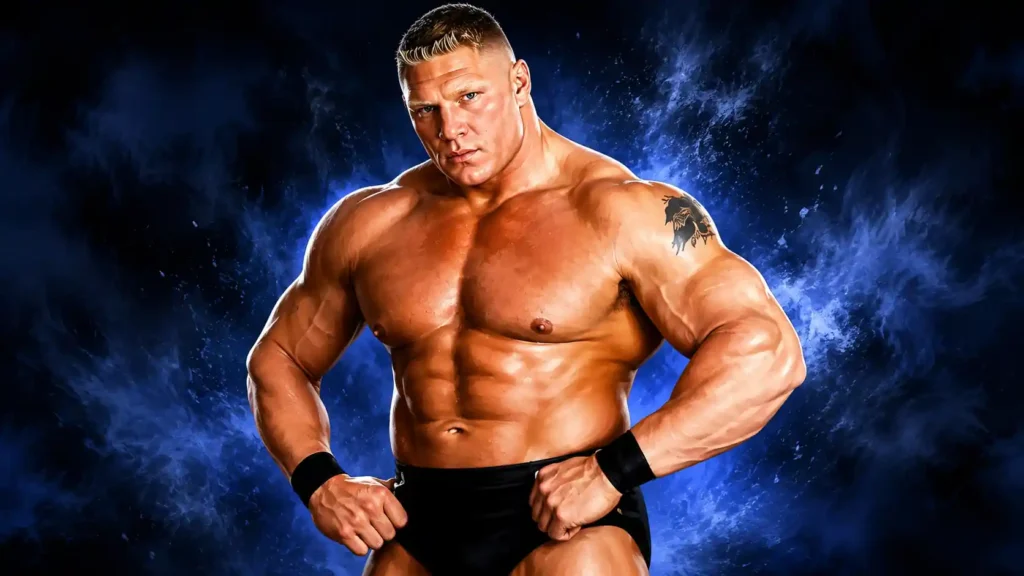
Brock Lesnar debuted on WWE television in March 2002. His rise was extremely fast. Within just a few months, he was already in main event matches against top stars like The Rock.
In August 2002, at SummerSlam, Lesnar defeated The Rock to win his first WWE Championship. He was only 25 years old at the time. This made him the youngest WWE Champion in history at the time, a record that Randy Orton later broke. It was a huge deal, because it showed WWE trusted him as their new top guy almost immediately, something the company rarely does with a wrestler barely a few months into his run.
His first WWE run also included a famous WrestleMania XIX match against Kurt Angle in 2003. That match is remembered for a botched Shooting Star Press attempt. It is one of the rare moments in his early career where Lesnar looked human instead of unstoppable, and honestly, it made the rest of his dominance feel more believable rather than less.
In 2004, Lesnar shocked the wrestling world by walking away from WWE to chase an NFL tryout. The tryout did not lead anywhere, and fans did not see him back in a WWE ring for eight years. Looking back, it is one of the strangest exits a top champion has ever made, right at the peak of his push.
The UFC Chapter: Becoming a Real World Champion (2004–2010)
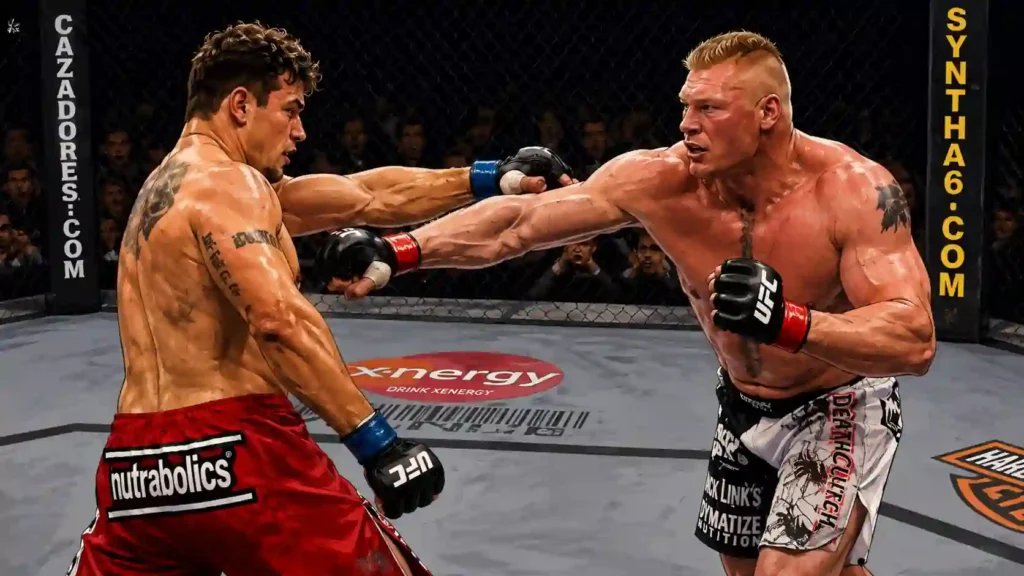
After his NFL attempt did not work out, Lesnar shifted his focus to mixed martial arts. He signed with UFC in 2007. In November 2008, he defeated Randy Couture at UFC 91 to win the UFC Heavyweight Championship.
Not many athletes can say they held a major title in professional wrestling and then went and won a real one in a live combat sport. Lesnar did exactly that. He successfully defended his UFC title against Frank Mir at UFC 100 in 2009, one of the biggest pay-per-view cards UFC ever put together at that point.
His UFC run slowed down after a serious health battle with diverticulitis, a painful digestive condition that kept him out of action for months. He lost the belt to Cain Velasquez in 2010, and that loss ended up mattering less than you would think. Even after losing it, he walked back into WWE carrying a kind of credibility that scripted wrestling storylines simply cannot manufacture on their own.
The WWE Return and the Suplex City Era (2012–2019)
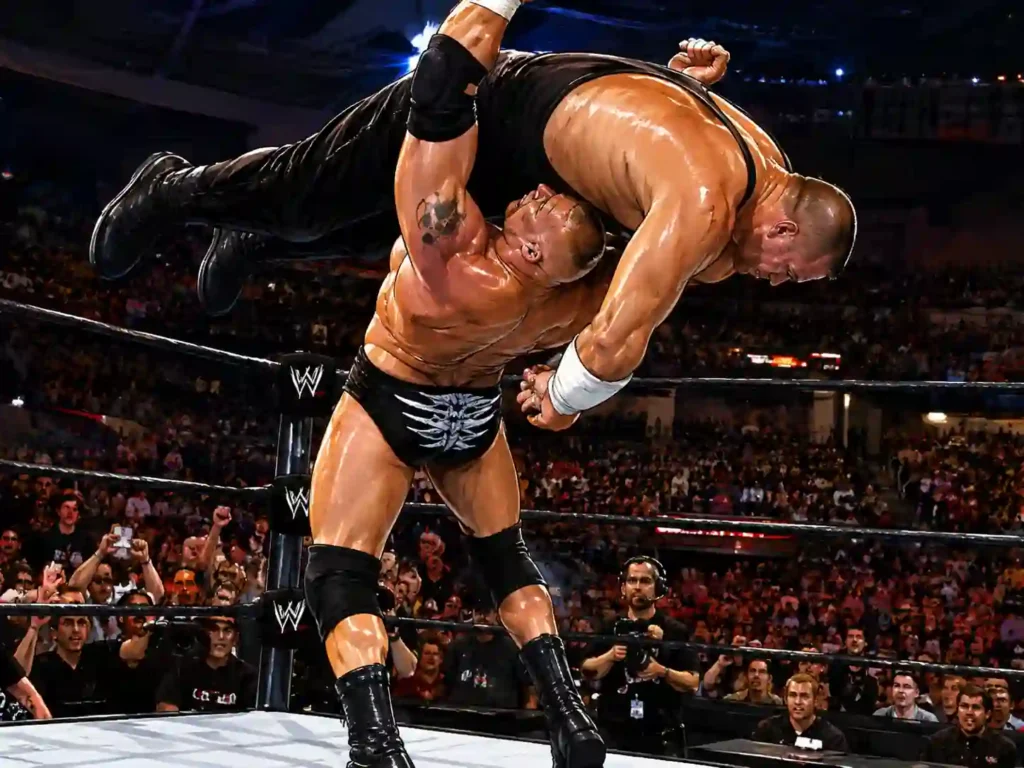
Brock Lesnar returned to WWE in 2012, and this time the company booked him completely differently. Instead of wrestling every week, Lesnar became a part-time attraction who showed up only a handful of times a year. WWE bet that scarcity would make him feel bigger, and it worked. Say what you want about how few matches he actually wrestled during this stretch, the reaction every time his music hit proved the strategy was right.
Ending The Undertaker’s Streak (WrestleMania 30, 2014): This is the single biggest moment of Lesnar’s entire career, no argument needed. The Undertaker had never lost a match at WrestleMania in 21 tries, and fans genuinely believed nobody ever would beat him there. Lesnar did. I still remember how dead silent that Superdome crowd went. You do not fake a reaction like that.
The Roman Reigns Rivalry (2015 and beyond): Lesnar’s WrestleMania 31 match against Roman Reigns was brutal and stiff-looking in a way few WrestleMania main events are. The finish, where Seth Rollins cashed in Money in the Bank mid-match, annoyed a lot of fans who wanted a clean result. Fair criticism, but the match itself proved Lesnar could still carry a long, physical main event whenever WWE actually let him.
Suplex City: During this era, Lesnar became known for a move sequence fans nicknamed “Suplex City.” He would drop opponent after opponent with German suplexes before finishing them off with an F5. It turned into shorthand for the entire Lesnar experience, and even casual fans who barely followed WWE knew the phrase.
The Goldberg Shock (Survivor Series 2016): Goldberg stunned everyone by beating Brock Lesnar in just 86 seconds, a result nobody saw coming after years of Lesnar being booked as untouchable. Lesnar got his answer back at WrestleMania 33, beating Goldberg to win the Universal Championship for the first time. That reign went on to last 504 days, one of the longest world title runs WWE has seen in the modern era.
Later Career and Legacy Runs (2019–2026)
As WWE moved into a new generation of stars, Lesnar’s job in the company quietly changed. He became the measuring stick for rising talent, and beating him started to mean something. Wrestlers like Braun Strowman, Drew McIntyre, Bobby Lashley, and Cody Rhodes all got big moments off the back of either beating him or surviving him.
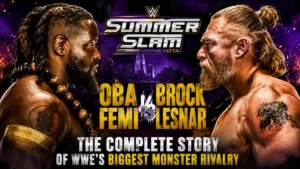
One of his latest major rivalries came against Oba Femi, a young powerhouse WWE has clearly been building toward the top of the card. Watching a veteran like Lesnar willingly put a newer star over across multiple big matches says a lot about how the promotion views Femi’s ceiling.
That rivalry turned out to be his last one in WWE. Lesnar announced his retirement in August 2026, closing out one of the most unusual careers professional wrestling has ever seen.
Related reading: Brock Lesnar’s Sword Tattoo Story, Why WWE Never Gave Matt Riddle and Brock Lesnar a Real Feud.
Brock Lesnar’s Career Records and Titles
Here is a quick look at his biggest career achievements:
- Multiple-time WWE World Champion, including seven WWE Championship reigns and multiple Universal Championship reigns
- Youngest WWE Champion in history at the time of his first title win in 2002
- Former UFC Heavyweight Champion
- NCAA Division I heavyweight wrestling champion (2000)
- Ended The Undertaker’s undefeated WrestleMania streak at WrestleMania 30
- One of the longest Universal Championship reigns in WWE history, at 504 days
- Headlined multiple WrestleManias and SummerSlams across two decades
Why Brock Lesnar’s Career Stands Out
Most wrestlers build a legacy by racking up hundreds of matches a year. Lesnar built his by doing the opposite, and I think that is what people underestimate about him. He wrestled a fraction of the dates most world champions do, yet he stayed one of the most talked-about names in the company for over two decades.
A lot of that comes down to where he came from. Fans believed in his power because they had already seen it proven somewhere real, first on an NCAA mat and later inside a UFC cage. Very few wrestlers in history have carried that exact combination of amateur pedigree, actual fight-sport success, and WWE main event drawing power at the same time.
I will admit the part-time schedule frustrated me plenty of times over the years, especially waiting months between appearances. But every single time he walked out to that ring, something in the arena changed. Not every wrestler can say that about themselves, and honestly, not many ever will.
Editor’s Note: This article is regularly updated to reflect Brock Lesnar’s latest WWE appearances, championship history, and major career milestones.
Frequently Asked Questions
How many WWE Championships has Brock Lesnar won? Brock Lesnar has won multiple WWE world championships during his career, including several WWE Championship reigns and multiple Universal Championship reigns.
Did Brock Lesnar really end The Undertaker’s WrestleMania streak? Yes. Brock Lesnar defeated The Undertaker at WrestleMania 30 in 2014, ending The Undertaker’s legendary 21-0 WrestleMania streak.
Was Brock Lesnar a UFC Champion? Yes. Brock Lesnar won the UFC Heavyweight Championship in 2008 after defeating Randy Couture at UFC 91.
Why is Brock Lesnar called The Beast Incarnate? Because of his unmatched combination of NCAA wrestling success, UFC championship pedigree, and dominant WWE performances.

About Gaurav Sharma
I am Gaurav Sharma, founder and the only writer at Wrestling Nightmare. I live in Punjab, India. I have watched professional wrestling since 2000, and for the last 15 years I have followed dirtsheet reporting and the difference between what is shown on screen and what is reported from backstage. I write explainers and labeled opinion on WWE, AEW, and TNA. I credit the outlet that broke a story, and I do not publish unsourced salary figures or private family pieces.
contact@wrestlingnightmare.com